
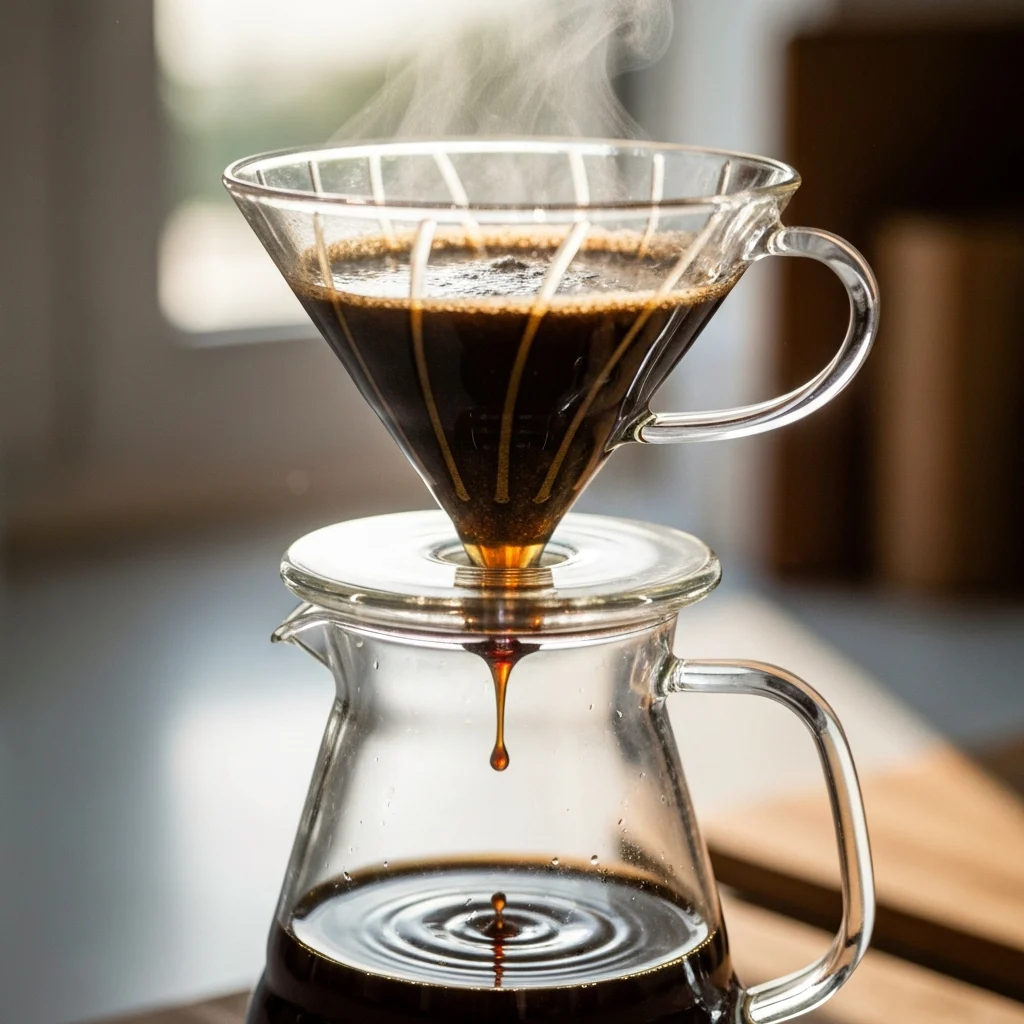
Why Does My V60 Stall? 7 Causes of a Choked Brew and How to Fix It
There is nothing more frustrating for a home barista than watching your perfect pour-over come to a screeching halt. You followed the recipe precisely, your timing was perfect, but now the water just sits there, refusing to draw down. This dreaded V60 stall, or choked brew, is a common problem that can turn a potentially delicious cup of coffee into a bitter, over-extracted mess. If you’ve ever stared at a muddy coffee bed and wondered where you went wrong, you are in the right place.
The good news? It is almost always fixable. A stalled brew is simply a sign that something in your process needs a small adjustment. At Coffee Informer, we believe that understanding the “why” behind your brewing problems is the key to making consistently great coffee. This guide will walk you through the seven most common reasons your V60 stalls and provide clear, actionable solutions to get your coffee flowing freely again.
What Exactly Is a Stalled V60 Brew?
A “stall” happens when the flow of water through your coffee grounds and filter slows down dramatically or stops altogether, especially towards the end of the brew. Instead of a steady drip, you get a painfully slow trickle or nothing at all. This significantly extends your total brew time, a critical variable in extraction.
When water spends too much time in contact with the coffee grounds, it leads to over-extraction. This is a sure path to a bitter, harsh, and astringent cup of coffee. You will often notice the coffee bed looks dense and muddy, with no clear structure. Understanding how to prevent a V60 stall is a crucial step in mastering the V60 brewing method.
The Main Culprit: Coffee Fines
Before we dive into the specific causes, we need to talk about the primary villain in almost every story of a stalled brew: coffee fines. Fines are tiny, dust-like particles of coffee created during the grinding process. While some fines are unavoidable and even contribute to the body of your coffee, an excessive amount is disastrous for a V60.
Here’s the problem.
During the brew, as you pour water and agitate the coffee bed, these tiny fines migrate downwards. They are so small that they pass through the larger coffee grounds and get lodged in the pores of your paper filter, creating a dense, almost impermeable layer. This clogs the filter and chokes the flow of water. The rest of our troubleshooting guide largely revolves around how to produce fewer fines or manage the ones you have.
Cause 1: Your Grinder and Grind Size
Your coffee grinder is the single most important piece of equipment for pour-over coffee. The consistency of your grind is directly linked to the flow rate of your brew. This issue can be broken down into two parts: the quality of your grinder and the setting you use.
Grinder Quality and Fines Production
Not all grinders are created equal. A high quality burr grinder is designed to produce a uniform particle size with a minimal amount of fines. In contrast, blade grinders and even some entry-level burr grinders tend to create a much wider distribution of particle sizes, including a large percentage of boulders (large chunks) and fines (dust).
If you are using a grinder like a Baratza Encore, which is a fantastic entry point, you might still experience stalling, especially with certain recipes or coffee beans. It simply produces more fines than a high end, commercial grade grinder. Regular cleaning of your grinder is also crucial, as old fines can build up and contribute to clogging.
The Fix:
- Upgrade Your Grinder: If you are serious about pour-over, investing in a grinder known for its grind consistency is the best long term solution.
- Clean Your Grinder: Disassemble and clean your burrs regularly to remove old coffee dust and oils.
- Sift Your Grounds: For an immediate fix, you can use a fine mesh kitchen sieve or a dedicated coffee sifter to remove the excess fines before brewing.
Grind Size is Too Fine
This is the most straightforward cause. If your coffee grounds are too fine, there is less space between the particles for water to flow through. This slows down the entire brew from the start and makes it much easier for fines to clog the filter completely.
The Fix:
- Grind Coarser: This is the first thing you should always try. Adjust your grinder one or two steps coarser and see how it affects your drawdown time. The goal is to find the sweet spot where you get a good extraction without stalling. Be careful not to go so coarse that your coffee tastes sour or under-extracted.
Cause 2: Excessive Agitation
Agitation is the act of stirring or disturbing the coffee bed. While some agitation is necessary for even extraction, too much of it is the fastest way to cause fines to migrate and clog your filter. Many popular V60 recipes, like those from James Hoffmann, use specific agitation techniques that can be tricky to master.
Your Pouring Technique
How you pour water into the V60 has a massive impact on agitation. Several factors are at play.
- Pour Height: Pouring from a greater height increases the kinetic energy of the water stream, leading to more agitation. A common misconception is that a low pour is always gentle. While a very high pour is aggressive, a pour that is too close to the bed can also cause channeling. Aim for a controlled height of a few inches.
- Pouring Style: Pouring in controlled, gentle circles agitates the bed more than a single, slow pour in the center. Aggressive circular pouring, especially near the filter walls, can kick up fines and send them straight to the paper.
- Number of Pours: Every time you add water, you are creating turbulence. A recipe with five small pours will have significantly more agitation than a recipe with two larger pours.
Swirling and Stirring
Many recipes call for a swirl or stir during the coffee bloom or a final swirl at the end of the brew to flatten the bed.
- The Bloom: A vigorous swirl during the bloom can immediately clog the filter’s sides before the main brew even begins. Try a very gentle stir with a spoon or chopstick instead, just enough to wet all the grounds.
- The Final Swirl: A gentle swirl at the end can help achieve an even extraction, but an aggressive one can kick up all the fines that have settled at the bottom and choke the final drawdown.
The Fix:
- Be Gentle: Focus on a gentle, controlled pouring technique. Use a gooseneck kettle for precision.
- Reduce Agitation: Try a recipe with fewer pours. If you swirl, do it gently. Pay attention to how your technique affects the flow rate.
Cause 3: The Coffee Beans Themselves
Sometimes, the problem isn’t your gear or technique, but the coffee itself. Certain types of single origin coffee are known to produce more fines when ground.
Natural processed coffees, particularly from Ethiopia, often create more fines and have more soluble materials that can slow down a brew. Lighter roasts are also harder and more brittle, which can lead to them shattering into a wider range of particle sizes during grinding. If you only experience stalling with one specific bag of coffee, this is likely the cause.
The Fix:
- Adjust for the Bean: If you know you are brewing a coffee that produces a lot of fines, plan ahead. Grind a little coarser and use less agitation than you normally would.
Cause 4: Your Filter Paper
Not all V60 filters are the same. The type of paper, its thickness, and its manufacturing process all affect the flow rate. The original Hario filters made in Japan are generally considered faster than those made elsewhere. Some brewers have found that the newer tabbed Hario filters can be slower than the original untabbed ones.
Specialty paper brands like Cafec and Sibarist produce filters specifically designed for different flow rates. Using a “faster” paper can be a simple and effective way to combat stalling if you have already optimized your grind and technique.
The Fix:
- Try Different Filters: Experiment with different types of V60 filters. Buying a pack of Cafec Abaca or other specialty papers might completely solve your stalling issues.
Cause 5: Creating a Vacuum Seal
This is a less common but very real mechanical issue. For water to flow out of the V60, air must be able to escape from the brewing vessel below. If the base of your V60 creates a perfect seal with the rim of your mug or server, it can trap hot air.
As this air heats up, it expands, creating positive pressure that pushes back against the dripping coffee. This back pressure can slow the brew to a crawl. Plastic and ceramic V60s have ridges on the bottom to help prevent this, but if your mug is just the right size, a seal can still form. Metal V60s without these ridges are more susceptible.
The Fix:
- Use a Different Vessel: Try brewing into a different mug with a wider or narrower rim. A dedicated coffee server, like the Hario glass range server, is designed to prevent this issue.
- Break the Seal: If you notice a stall, you can try gently lifting the V60 for a second to release the pressure and see if the flow resumes.
Cause 6: Water Chemistry
The mineral content of your water can influence extraction speed. Very soft water, like distilled or reverse osmosis water without added minerals, can extract coffee very aggressively. This can cause the cellular structure of the coffee grounds to break down more rapidly, releasing more fine particles into the slurry and contributing to a stall. Using water with an appropriate mineral content (like that from Third Wave Water packets) can lead to a more stable extraction and flow rate.
The Fix:
- Evaluate Your Water: If you are using very soft or distilled water, try using a dedicated coffee water mineral packet or simply filtered tap water to see if it improves your flow rate.
Cause 7: An Unlevel Coffee Bed
An uneven coffee bed can lead to channeling, where water finds a path of least resistance and bypasses other parts of the coffee. While this typically causes under-extraction, it can also contribute to stalling. The high flow in the channels can carry fines to the bottom of the filter quickly, while other parts of the bed remain saturated and drain slowly, leading to a stalled and unevenly extracted brew. The dreaded combination of sour and bitter notes is a classic sign of this.
The Fix:
- Settle the Grounds: After pouring your grounds into the filter, give the V60 a gentle tap on the counter to level the bed before you start brewing.
- Use a Distribution Tool: Tools like the Weiss Distribution Technique (WDT) tool can help break up clumps and create a perfectly level and homogenous coffee bed.
Troubleshooting Your Stalled V60: A Quick Checklist
Feeling overwhelmed? Do not be. When your next brew stalls, work through this simple checklist. Change only one variable at a time to isolate the problem.
- Grind Coarser: The first and easiest adjustment to make.
- Reduce Agitation: Pour more gently and from a consistent, moderate height. Try reducing the number of pours or skipping the final swirl.
- Change Your Mug/Server: Eliminate the possibility of a vacuum seal.
- Try a Different Filter Paper: A faster paper might be all you need.
- Clean Your Grinder: A deep clean can make a surprising difference.
Conclusion: Embrace the Process
A V60 stall is not a failure. It is a data point. It is your coffee telling you that something in the complex interplay between your grinder, water, beans, and technique needs a slight tweak. The most common culprits are an excess of coffee fines, often caused by your grinder, and too much agitation, which forces those fines to clog your filter paper. By methodically adjusting your grind size, refining your pouring technique, and ensuring your equipment is not working against you, you can easily overcome this hurdle.
The journey to the perfect cup of pour-over is one of continuous learning and experimentation. Do not get discouraged. Instead, see each stalled brew as an opportunity to better understand the science of coffee extraction. The result will be a more intuitive brewing process and, ultimately, much more delicious coffee. A brew that stalls is often over-extracted and bitter, and fixing that is worth the effort.
What has been your experience with a stalled V60? Do you have any other tips that have worked for you? Share your thoughts and questions in the comments below!