
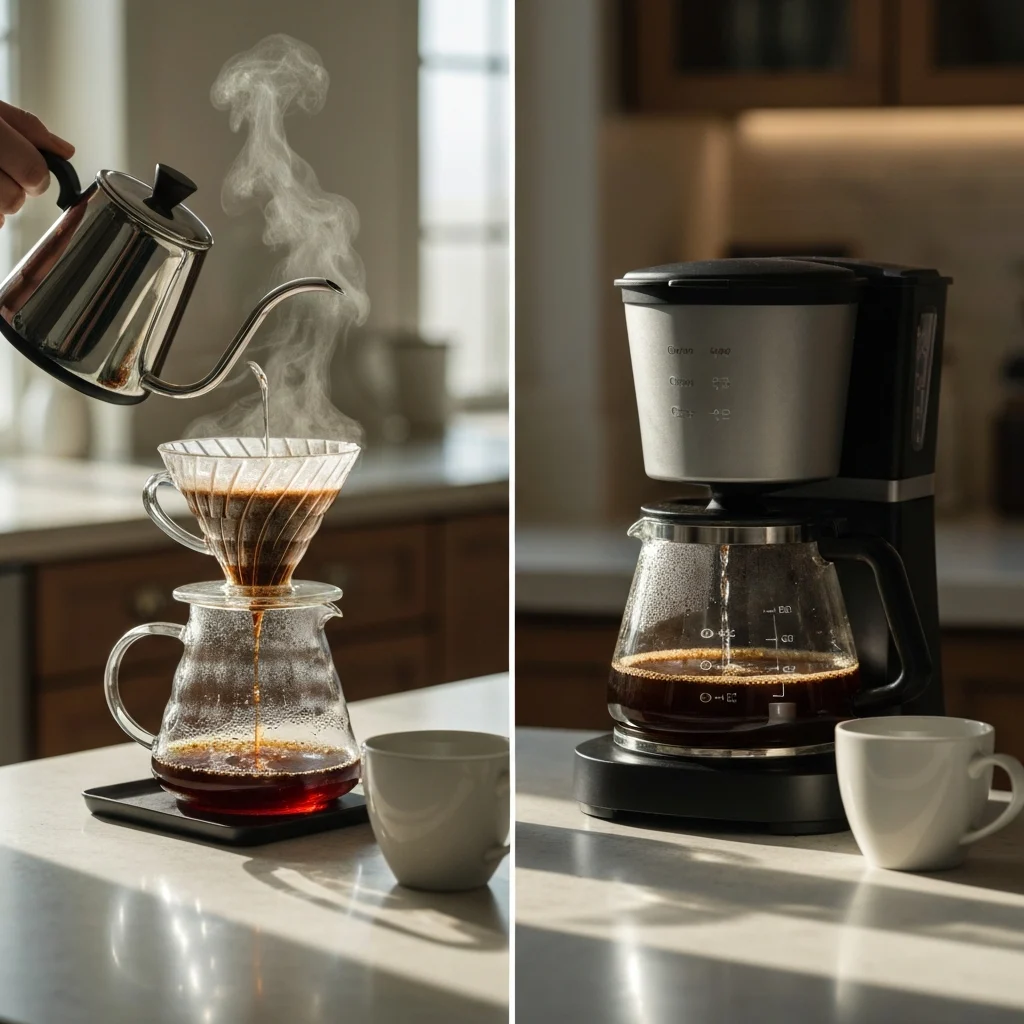
Quick answer: Pour over vs drip coffee comes down to control. Both pour hot water through grounds in a filter, but with pour over you set the water temperature, pour pattern, speed and ratio yourself. Cheap drip machines often brew too cool, wet the grounds unevenly and scorch coffee on a hot plate. A good certified drip brewer closes most of that gap.
Both methods are “drip” coffee in the literal sense: water flows through ground coffee in a filter. The difference is who controls the variables, you or the machine, and how well the machine handles them.
In this guide 6 sections
Pour over vs drip coffee at a glance
| Pour over | Typical budget drip machine | Certified high-end drip brewer | |
|---|---|---|---|
| Water temperature | You choose it (kettle) | Often too cool | Held in the recommended range |
| Water distribution | Controlled by your pour | Central drip, uneven | Wider showerhead, more even |
| Ratio and grind | Fully adjustable | Limited by basket size | Adjustable within basket size |
| Keeping coffee hot | Brew to order | Hot plate (cooks coffee) | Often a thermal carafe |
| Effort | Hands-on, one or two cups | Push button, full pot | Push button, full pot |
Why does drip machine coffee often fall short?
Water that is too cool
The Specialty Coffee Association’s home brewer standard expects water to reach 92°C (about 198°F) within the first minute of brewing and stay between 92°C and 96°C (about 205°F). Many inexpensive machines don’t get there. Cooler water under-extracts, so the coffee tastes weak, sour or grassy. If yours often tastes sharp, see how to fix sour coffee.
Uneven water distribution
Many basic machines drip water onto the centre of the basket. The middle gets soaked and the edges stay under-used, so water channels through the same spots. The centre over-extracts (bitter) while the edges under-extract (sour), giving a muddled cup.
The hot plate
A carafe sitting on a hot plate keeps cooking the coffee, breaking down aroma and turning it bitter and stale over time. That is why better machines use an insulated thermal carafe instead. Our article on why reheated coffee tastes bad explains what happens.
Baskets too small for the right ratio
Brew a full pot at a proper coffee-to-water ratio and many baskets can’t hold enough grounds without overflowing. People use less coffee and get a weak, watery brew.
Why can pour over brew a better cup?
Temperature control
You heat water in a kettle, so you can brew in the recommended range every time, with a thermometer or a temperature-control kettle for accuracy.
Even saturation and a proper bloom
A gooseneck kettle lets you pour a slow, steady spiral that wets all the grounds evenly. You can also do a proper coffee bloom to release trapped CO2 before the main pour, which helps prevent channelling.
Flow rate and brew time
How fast you pour changes agitation and contact time, and therefore taste. You can adjust on the fly for each coffee. See how pour speed affects pour-over.
Ratio and grind flexibility
You can change the ratio and fine-tune grind size with a burr grinder, which is how you fix a brew that drains too fast or too slowly.
Are high-end drip coffee makers as good as pour over?
They can come close. The SCA certifies home brewers that meet its standard, including holding the right temperature and finishing a brew with a total contact time of 4 to 8 minutes. Machines such as Technivorm’s Moccamaster are well-known examples of brewers built around these targets. Look for:
- water heated to the recommended range and held there through the brew;
- a showerhead that spreads water evenly over the grounds;
- a thermal carafe rather than a hot plate.
A good drip brewer is the better choice if you regularly make coffee for several people and value convenience.
Which pour over brewer should you try?
Hario V60
A cone with spiral ribs and one large hole. It gives lots of control over flow and a clean, bright cup, but has a steeper learning curve. Start with our V60 brewing methods.
Chemex
Uses thick paper filters that remove more oils and sediment, for a very clean cup.
Kalita Wave
Flat-bottomed with three small holes, so it is more forgiving of imperfect pouring and a good choice for beginners.
Frequently asked questions
Is pour over stronger than drip coffee?
Not inherently. Strength depends on your coffee-to-water ratio. Pour over just makes it easier to use the ratio you want, while some drip baskets limit how much coffee you can add.
Is pour over worth it over a drip machine?
If you enjoy the ritual and brew one or two cups, yes: you control every variable. If you need a full pot quickly, a certified drip brewer gets you most of the quality with push-button convenience.
Does pour over have more caffeine than drip?
Caffeine depends mainly on how much coffee you use and how fully it’s extracted, not the method’s name. For more, see how much caffeine is in coffee.