
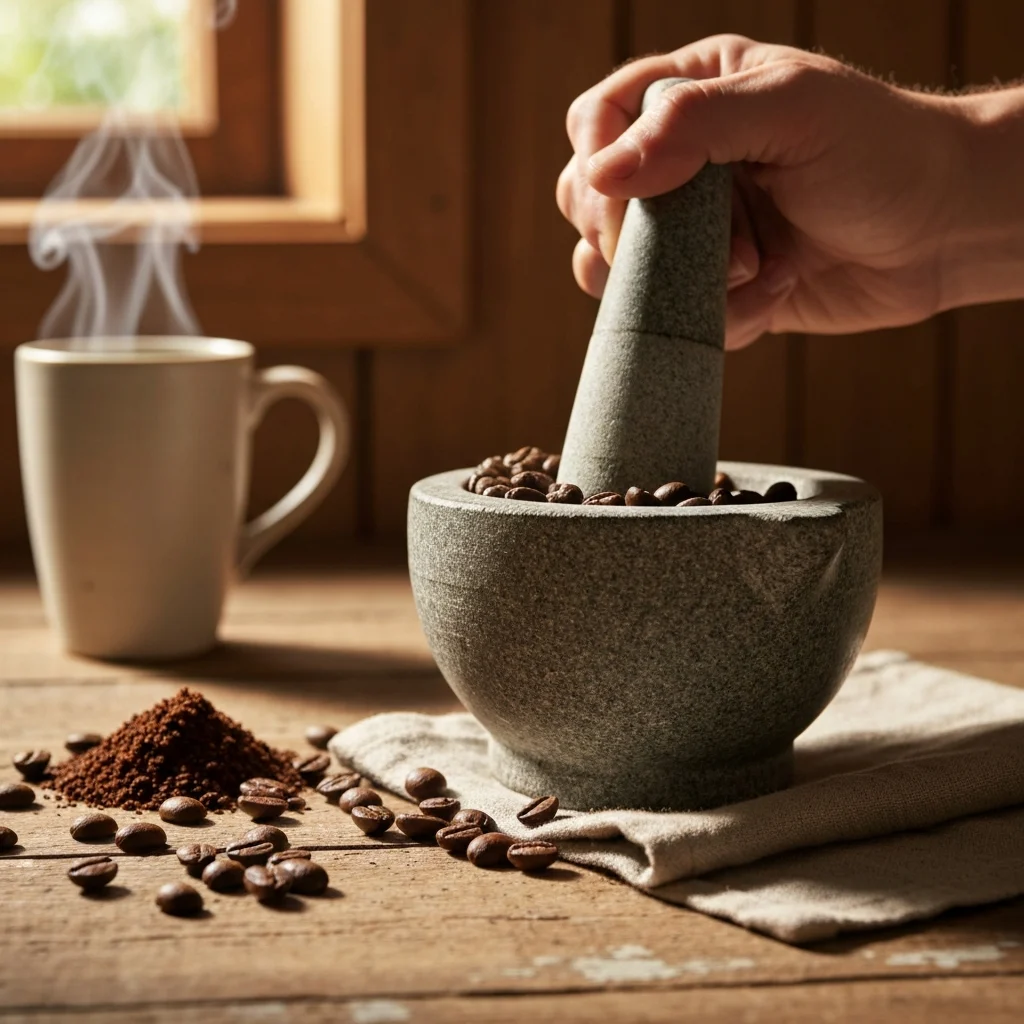
Quick answer: To grind coffee beans without a grinder, pulse them in short bursts in a blender, or crush them in a sealed bag with a rolling pin, mallet or mortar and pestle. A rolling pin or mortar and pestle gives the most control. For an even grind, ask a coffee shop or use a supermarket grinder. Coarse, uneven grounds work best in a French press.
Whether your grinder just broke or you haven’t bought one yet, you can still turn whole beans into a decent cup with ordinary kitchen tools. Here are seven methods, from best to last resort, plus what to brew with the results.
In this guide 6 sections
Why does grinding fresh matter?
Ground coffee loses aroma fast because grinding exposes far more surface to air. Grinding just before you brew keeps more of the volatile compounds that give coffee its smell and taste, which is why it’s worth the effort. Read more in how long coffee stays fresh.
What grind size do you need?
- Coarse (like coarse sea salt): French press and cold brew.
- Medium (like sand): drip machines and most pour-over.
- Medium-fine (like table salt): AeroPress.
- Fine: espresso.
- Extra fine (like powder): Turkish coffee.
Without a grinder, a coarse, fairly even grind is the realistic target, which is why a French press is the best brewer for these methods.
7 ways to grind coffee beans without a grinder
1. Blender or food processor
The quickest option, and most kitchens have one.
- Add a small amount of beans; don’t fill it more than a quarter full.
- Pulse in short 2–3 second bursts rather than running it continuously.
- Shake the jar between pulses to redistribute the beans.
- Stop when most of the grounds reach the size you need.
Pros: fast and easy. Cons: blades chop rather than grind, so you get a mix of dust (fines) and chunks (boulders), and long runs warm the beans. It is effectively a big blade grinder; see how uneven grinds affect your coffee.
2. Rolling pin
More effort, but more control than a blender.
- Put the beans in a sturdy freezer bag and squeeze out the air.
- Lay it on a cutting board, with a towel over it to protect the bag.
- Press down firmly with the rolling pin to crack the beans, then roll back and forth with firm pressure like rolling dough.
- Check often until you have an even, coarse grind.
Pros: good control and no heat. Cons: takes several minutes, and the bag can split.
3. Hammer or meat mallet
A rougher version of the rolling pin.
- Bag the beans and cover with a towel on a cutting board.
- Tap gently and evenly with a hammer, mallet or the base of a heavy pan to crack and crush the beans. Don’t smash them with full force.
Pros: uses common tools and cracks beans quickly. Cons: very uneven, with lots of dust and big pieces; a last resort.
4. Mortar and pestle
The most control of any manual method.
- Fill the mortar about a third full.
- Crack the beans with downward pressure, then grind in a circular motion against the sides.
- Keep going until you reach the consistency you want.
Pros: excellent control over grind size. Cons: slow, tiring and limited to small batches.
5. The flat side of a knife
Be very careful with this one.
- Put the beans on a large, sturdy cutting board.
- Lay the flat of a wide chef’s knife over them, sharp edge facing away from you.
- Press down on the flat of the blade with the heel of your other hand to crush the beans.
Pros: every kitchen has a knife. Cons: risky, messy and uneven.
6. A supermarket grinder
Many supermarkets have a commercial grinder in the coffee aisle for customers. Take your whole beans in, set the grind for your brewer (for example coarse for French press), and grind. Some stores only allow beans they sell, so check first. If you’re buying new beans anyway, see our picks of the best whole coffee beans.
Pros: a consistent grind from a proper machine. Cons: requires a trip, and the coffee starts staling as soon as it’s ground, so grind only what you’ll use soon.
7. Ask a local coffee shop
Bring your sealed beans, ask politely, and tell the barista your brew method. They may say no if they’re busy. It’s good manners to buy a drink or pastry.
Pros: an excellent, even grind. Cons: inconvenient, and not guaranteed.
Which brew methods forgive an uneven grind?
Immersion brewers handle inconsistency far better than pour-over, because all the coffee steeps together. A French press is the natural choice for coarse, hand-crushed beans, although you may get more sediment. The AeroPress is also very forgiving and its paper filter catches the dust. Use the usual coffee to water ratio, and add a little more coffee if the cup tastes weak.
Ready for a grinder?
For consistently good coffee, a burr grinder is the most important upgrade you can make. Blade grinders and blenders chop beans randomly into dust and chunks, so some of the coffee over-extracts (bitter) and some under-extracts (sour). Burr grinders crush beans between two burrs into a much more even size. Our burr grinder guide explains what to look for.
Hand grinders
A manual grinder is an affordable starting point. Hario’s ceramic-burr hand grinders, such as the Hario Skerton Plus or Hario Mini Mill, grind far more evenly than any blade grinder and are portable and good for one or two cups. The trade-off is a couple of minutes of cranking per cup. If cranking feels like hard work, see why your hand grinder is a struggle.
Entry-level electric grinder
For convenience, the Baratza Encore is a long-standing favourite entry-level electric burr grinder. It grinds consistently, is built to last and costs more than a hand grinder, but it will serve you for years. Whether you start with a hand grinder or a model like the Baratza Encore, a burr grinder is the single biggest upgrade to your coffee setup.
Frequently asked questions
Can you grind coffee beans in a blender?
Yes. Use short pulses with a small amount of beans and shake between pulses. Expect an uneven grind that works best in a French press or AeroPress.
What is the best way to grind coffee without a grinder?
For control, a mortar and pestle or a rolling pin. For speed, a blender. For the most even result, use a supermarket grinder or ask a coffee shop.
What grind should I aim for without a grinder?
Aim for a coarse, fairly even grind, like coarse sea salt, and brew it in a French press. Fine, dusty grounds from a blender or hammer make for a muddy, bitter cup.