
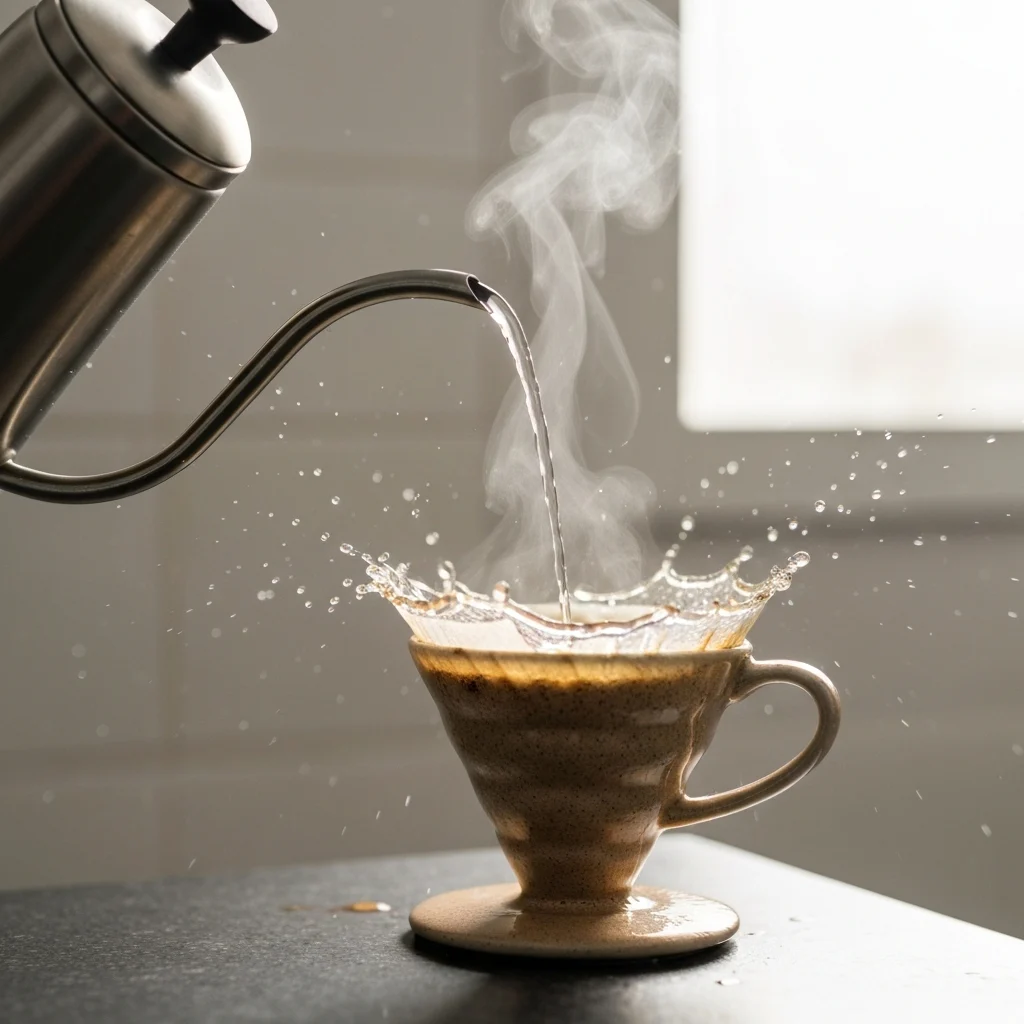
Master Your Pour: Why Pour Speed Can Make or Break Your Coffee
If you have ever brewed pour over coffee, you know the pursuit of the perfect cup is a journey of precision. You dial in your grind size, measure your coffee and water with religious accuracy, and monitor the temperature like a hawk. But what if a crucial variable you have been overlooking is the very motion of your hand? Many coffee lovers focus on what they pour, but not how they pour. As it turns out, the speed and aggression of your pour can drastically alter your final brew, turning a potentially great coffee into a disappointing one. For a complete overview of coffee topics, visit our homepage.
The flow rate of your pour over kettle is not just a minor detail. It is a powerful tool that directly influences agitation, extraction, and the total brew time. A pour that is too fast or aggressive can lead to a clogged filter and a bitter, over-extracted taste. Conversely, a pour that is too slow and timid might result in a sour, underdeveloped cup. Understanding and controlling your pour speed is the key to unlocking a new level of consistency and flavor in your daily coffee ritual.
This guide will explore the surprising impact of pour speed on your coffee. We will break down the science behind agitation and extraction, compare the effects of slow and fast pours, and provide actionable techniques to help you master your pouring technique for a consistently delicious brew every single time.
The Hidden Variable: Why Pour Speed Matters So Much
Imagine two baristas brewing the same coffee with the exact same recipe. They use the same beans, grind setting, water temperature, and coffee-to-water ratio. Yet, their final cups taste noticeably different. The secret culprit is often the pour. One barista might use a slow, gentle stream, while the other uses a more forceful, rapid pour. This single difference creates a cascade of effects within the coffee bed.
The primary way pour speed affects your brew is through agitation. Agitation is simply the stirring or disturbance of the coffee grounds by the water. Every drop of water from your kettle creates some level of agitation. A faster, more aggressive pour creates significantly more turbulence, causing the coffee grounds to churn and mix vigorously. This is not inherently good or bad, but it is a powerful variable you need to control.
Agitation and Extraction: A Balancing Act
Agitation’s main job is to promote extraction. By stirring the grounds, you ensure that water makes more even and consistent contact with the surface of every coffee particle. This helps the water dissolve the desirable flavor compounds locked inside the coffee. More agitation generally leads to a higher and faster extraction.
However, this is where the balancing act begins.
- Too little agitation (from a very slow, timid pour) may not disturb the coffee bed enough. Water can create channels, or small tunnels, through the grounds, bypassing most of the coffee. This leads to under-extraction, resulting in a thin, sour, and unsatisfying cup.
- Too much agitation (from a very fast, aggressive pour) can cause over-extraction. The violent churning strips too many compounds from the coffee too quickly, including the bitter, dry, and unpleasant ones. This often creates a harsh, astringent flavor profile.
The goal is to find the “sweet spot” of agitation that extracts all the delicious sugars and acids without pulling out the bitter compounds.
Fines Migration: The Clogged Filter Problem
There is another critical, science-backed phenomenon at play, especially with aggressive pours: fines migration. Even the best burr grinders produce a mixture of particle sizes, including very small particles called “fines.”
When you pour water aggressively onto the coffee bed, it creates a chaotic slurry. This turbulence can cause something known as the “Brazil Nut Effect.” In a container of mixed-sized nuts, shaking causes the large Brazil nuts to rise to the top while smaller nuts fall to the bottom. In your coffee brewer, the same thing happens. The forceful pour pushes the tiny fines down to the bottom of the filter paper. These fines then clog the pores of the paper, severely restricting water flow. This leads to a stalled or dramatically slowed drawdown, where the water takes an extremely long time to drain. The extended contact time between the water and the grounds often results in a muddy coffee bed and a bitter, over-extracted brew.
Slow Pour vs. Fast Pour: A Tale of Two Cups
To master your technique, it helps to understand the distinct characteristics and outcomes of different pouring styles. There is no single “correct” speed, as the ideal rate depends on your coffee, brewer, and personal preference. However, knowing the tendencies of each can guide your experiments.
The Case for a Gentle, Slow Pour
A gentle pour is characterized by a low flow rate, typically around 4 to 6 grams per second, and a low pouring height. The kettle spout is kept just a few inches above the slurry. This technique minimizes agitation and gives the brewer maximum control.
Advantages:
- Less Fines Migration: A gentle stream is less likely to force fines to the bottom of the filter, preventing clogging and promoting an even drawdown.
- Clarity and Sweetness: By reducing harsh agitation, a slow pour tends to produce a cleaner, sweeter cup with more delicate and nuanced flavors. It allows the coffee’s inherent characteristics to shine.
- Better for Multi-Pour Methods: When a recipe calls for four or five small pours, a gentle technique is much more forgiving. It maintains the integrity of the coffee bed between pulses.
Disadvantages:
- Risk of Under-Extraction: If the pour is too gentle or the grind is too coarse, you may not achieve enough agitation for a full extraction, leading to a watery or sour cup.
- Requires Patience: This method is inherently slower and requires more focus to maintain a steady, low flow rate.
The Effects of an Aggressive, Fast Pour
An aggressive pour involves a higher flow rate, often 7g/s or more, and sometimes a greater pouring height. This style introduces a high level of turbulence into the coffee bed.
Advantages:
- Increased Body and Texture: The high agitation can increase the extraction of oils and insoluble solids, resulting in a coffee with a heavier body and richer texture.
- Compensates for Coarser Grinds: If you are using a slightly coarser grind, a fast pour can provide the necessary agitation to achieve a proper extraction.
Disadvantages:
- High Risk of Clogging: This is the biggest drawback. An aggressive pour is the primary cause of fines migration, which can stall your brew and create intense bitterness.
- Inconsistent Extraction: The chaotic slurry can lead to uneven extraction, where some grounds are over-extracted while others are under-extracted, creating a muddled flavor profile.
- Loss of Nuance: The heavy-handed extraction can overpower the delicate floral and fruity notes in high-quality beans, replacing them with generic “roasty” or bitter flavors.
How to Control Your Pour Speed for Consistent Results
Recognizing the importance of pour speed is the first step. The next is learning to control it. With the right equipment and a little practice, you can turn this unpredictable variable into one of your most reliable brewing tools.
Equipment and Technique Matter
- Use a Gooseneck Kettle: This is non-negotiable for serious pour over brewing. A gooseneck kettle’s long, thin spout gives you precise control over the flow rate and placement of the water. Trying to control your pour with a standard kettle is nearly impossible.
- Maintain a Low Pouring Height: The farther the water has to fall, the more energy it has when it hits the coffee bed, increasing agitation. Keep the spout of your kettle just a few inches above the slurry for a gentler, more controlled pour.
- Practice Consistent Circles: Pour in slow, steady circles, starting from the center and moving outward, then back toward the center. Avoid pouring directly on the filter paper. Some brewers find that making faster circles can feel more aggressive but actually helps spread the water’s impact over a wider area, preventing channeling in any single spot.
Finding Your “Goldilocks” Pour Rate
There is no universal perfect pour speed. The key is to find what works for you and then replicate it consistently. One brewer might discover that a fast pour, paired with a coarser grind setting (e.g., a 16 on a Baratza Encore), gives them their target brew time and taste. Another might find that a slow, gentle pour paired with a finer grind (e.g., a 20 on the same grinder) achieves the same goal with a different flavor profile.
Here is a simple way to practice:
- Place your brewer and server on a digital scale.
- Start a timer and begin pouring.
- Aim to pour 50 grams of water in exactly 10 seconds. This gives you a flow rate of 5g/s.
- Practice this until you can do it by feel. This muscle memory is the foundation of consistency.
For those who want ultimate precision, advanced coffee scales like the Timemore Black Mirror Nano can display your flow rate in real time, removing all the guesswork.
Consistency Is the Ultimate Goal
More important than finding a single “best” pour speed is developing a consistent one. Your daily pour should be the same every single time. Why? Because it eliminates a major variable. If your pour speed is always the same, you can confidently adjust your grind size to dial in the perfect flavor. If your pour changes every day, you will be chasing your tail, never sure if a change in taste came from the grind, the pour, or something else.
Many expert brewers adopt a strategy of making their pour rate a constant. They master one pouring style and stick with it, allowing grind size to be their primary tool for adjusting extraction. This approach transforms a chaotic process into a controlled, repeatable experiment.
Conclusion: Take Control of Your Kettle
The speed at which you pour water over your coffee grounds is far more than a trivial detail. It is a fundamental variable that directly shapes the final taste in your cup. An aggressive pour can create a traffic jam of fine particles, clogging your filter and producing a bitter, muddy brew. A controlled, gentle pour promotes even extraction, clarity, and sweetness, allowing the unique character of your beans to shine through.
The path to better coffee is paved with consistency. By investing in a gooseneck kettle, practicing a steady hand, and making your pour rate a deliberate and repeatable part of your routine, you eliminate a massive source of unpredictability. Stop letting your pour be an accident and start using it as an instrument. Your taste buds will thank you.
What is your preferred pouring style? Have you noticed a big difference in your brew times based on how you pour? Share your experiences and questions in the comments below!