
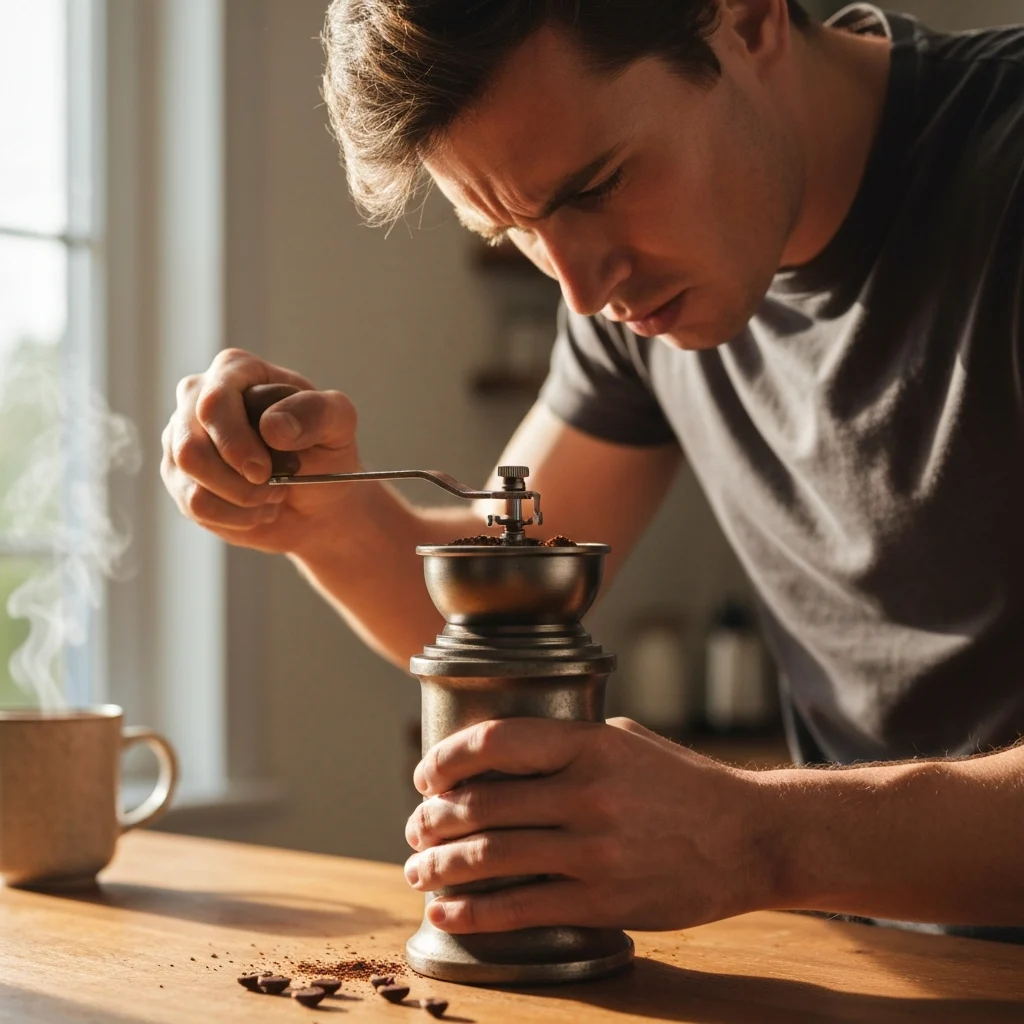
Quick answer: A hand grinder is hard to turn mainly because of what you’re grinding: espresso-fine settings and dense light roasts take far more force than coarse settings and darker roasts. Technique matters too. Move both hands against each other instead of holding the grinder still, grip it firmly, keep a steady rhythm, and expect it to get easier as you build strength.
You load light-roast beans, set the grinder fine for espresso, start cranking, and the handle barely moves. That’s normal, and it isn’t a sign of a faulty grinder. Here are the seven usual reasons and what to do about each.
In this guide 5 sections
Is it normal for a hand grinder to be hard to turn?
Yes, especially for new users grinding for espresso. Switching from a blade grinder or pre-ground coffee to a manual burr grinder can be a shock. Videos of people spinning the handle effortlessly hide the technique and practice behind it. You are using your own strength to crush and shear hard, dense seeds into small, uniform particles, and at fine settings that takes a lot of torque.
Why is my hand grinder so hard to turn? 7 reasons
1. You’re grinding for espresso
Grind size is the biggest factor. At an espresso setting the burrs sit very close together, so beans have to be broken down much further before they can pass through, and the burrs do far more cutting work per turn. A coarse setting for French press lets large pieces through easily and takes much less effort.
2. The roast level
Light roasts are noticeably harder to grind by hand. A lightly roasted bean spends less time in the roaster and stays denser and harder. As roasts get darker, the bean becomes more porous and brittle, so a dark roast shatters with much less force. A “medium” roast that is on the light side can still be a lot of work.
3. Your technique
Most people hold the grinder body still with one hand and power the crank with the other. That wastes energy, because the holding arm is just fighting the cranking arm. Instead, move both hands: as the cranking hand pushes forward, the holding hand turns the body slightly the other way, so both arms (and your core) share the work. It feels awkward at first, but it needs less brute strength and more rhythm.
4. You haven’t built up “grinding muscles” yet
Hand grinding uses your hands, wrists, forearms and shoulders in a way daily life rarely does. Many regular hand-grinder users find the first few weeks hard going and then notice it getting much easier as strength and muscle memory build.
5. A poor grip
If the grinder body twists or slips in your hand, the force you generate is wasted. Use the grip band if your grinder has one, or add grip tape, and hold on firmly. Bracing the base against your body or a counter adds stability.
6. Expecting “burr seasoning” to fix it
Seasoning means running a pound or two of cheap beans through new burrs to smooth out small manufacturing imperfections, which can slightly improve consistency. It may make grinding feel a touch smoother, but it will not dramatically reduce the effort. The resistance comes mainly from roast level and grind setting.
7. The grinder’s design
Burr size, shape and geometry vary between grinders. Some designs grind very quickly per turn and need more force; others use a longer handle for more leverage, making them easier to turn but slower. Body diameter affects grip, especially for smaller hands. This isn’t something you can fix, but it’s worth weighing when you choose a grinder; see what more expensive coffee gear actually buys you.
How can you make hand grinding easier?
- Use both hands: move the grinder body against the crank in a smooth, circular motion rather than holding it still.
- Maximise grip: use a grip sleeve or grip tape and hold firmly.
- Tilt the grinder: when resistance peaks, tilting it a little can reduce how many beans feed into the burrs at once, making each turn easier.
- Keep a steady rhythm: smooth, continuous turns are less tiring than jerky bursts.
- Pause if you need to: a full espresso dose of light roast is genuinely hard work; a short break halfway is fine.
- Brace it: sit and hold the grinder between your knees, or press the base against a counter edge.
- Reconsider the grind: if you’re grinding finer than you need to, coarsening slightly helps both effort and the shot. See when grinding finer helps and when it harms.
When should you consider an electric grinder?
Hand grinding for espresso isn’t for everyone. If you have wrist problems or arthritis, or the effort spoils your coffee routine, there are options. Some people attach a low-speed electric drill or driver to the grinder’s drive shaft; it can work, but high speeds can heat the coffee and damage the burrs or alignment, so it’s at your own risk. A more practical approach is to keep the hand grinder for pour-over, AeroPress and travel, and use an electric espresso grinder (or one of the coffee makers with a built-in grinder) for daily espresso.
Frequently asked questions
Why is my hand grinder harder to turn with light roast?
Light roasts are denser and harder because they spend less time in the roaster. Darker roasts become porous and brittle and shatter with less force, so the same setting feels much easier with them.
Does a hand grinder get easier to use over time?
Mostly because you do: strength and technique improve with practice. Burr seasoning may make it feel slightly smoother but doesn’t change the effort much.
Can I use a drill with a hand grinder?
Some people do, at low speed only. High speed can overheat the coffee and damage the burrs or alignment, so it’s a use-at-your-own-risk workaround rather than a recommendation.