
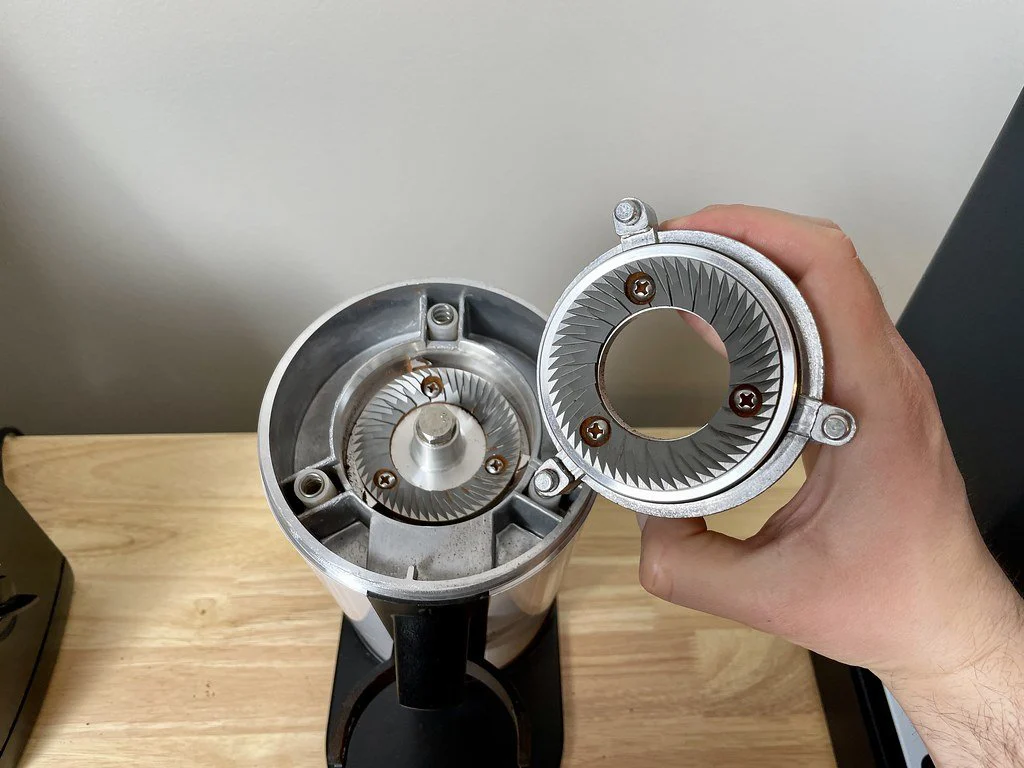
Quick answer: The best burr grinder for pour over is the Fellow Ode Brew Grinder Gen 2. Its 64 mm flat burrs are built only for filter coffee, and they give the even, medium grind that a V60 or Chemex needs. On a tighter budget, the Baratza Encore is the go-to electric starter. If you want a hand grinder, pick the 1Zpresso ZP6 Special, which was designed mainly for pour-overs.
Muddy, bitter pour-over that drains too slowly, or thin, sour cups that rush through, usually comes back to one thing: the grind. A blade grinder or a cheap burr grinder makes a mix of dust and boulders, and no pouring technique can fix that.
A good pour-over grinder gives you uniform particles at a medium to medium-fine size, in small enough steps that you can nudge a recipe sweeter or brighter. The five grinders below do that at different price points.
Affiliate disclosure: Coffee Informer is reader-supported. When you buy through links on this page, we may earn a commission at no extra cost to you. It never changes which products we recommend. See our affiliate disclaimer.
In this guide 10 sections
- Best Burr Grinders for Pour Over at a Glance
- 1. Fellow Ode Brew Grinder Gen 2: Best Overall
- 2. Baratza Encore: Best Value Electric Grinder
- 3. 1Zpresso ZP6 Special: Best Hand Grinder for Pour Over
- 4. Timemore Chestnut C3s: Best Budget Hand Grinder
- 5. OXO Brew Conical Burr Grinder: Best for Beginners
- Spec Comparison
- Buying Guide: How to Choose a Burr Grinder for Pour Over
- Final Verdict
- Frequently Asked Questions
Best Burr Grinders for Pour Over at a Glance
| Badge | Grinder | Type & burrs | Key spec | Deal |
|---|---|---|---|---|
| Best Overall | Fellow Ode Gen 2 | Electric, 64 mm flat steel | 31 steps, filter only | Check price |
| Best Value | Baratza Encore | Electric, 40 mm conical steel | 40 settings | Check price |
| Best Hand Grinder | 1Zpresso ZP6 Special | Manual, 48 mm hexagonal steel | 90 clicks per turn | Check price |
| Best Budget | Timemore Chestnut C3s | Manual, 38 mm steel (S2C) | Metal body, compact | Check price |
| Best for Beginners | OXO Brew Conical | Electric, conical steel | 15 settings + micro-steps, 12 oz hopper | Check price |
How We Chose These Grinders
We didn’t run a lab test for this guide, and we won’t pretend we did. We shortlisted grinders that specialty-coffee communities widely recommend for filter brewing. Then we checked each one against the maker’s current specs (October 2026) and ranked them on four things that matter for pour over:
- Burr design and size: larger, sharper burrs generally give a more uniform filter grind and grind faster.
- Adjustment step size: how finely you can move between settings in the pour-over range.
- Build and alignment: a wobbly burr carrier makes uneven grounds, no matter how good the burrs are.
- Ease of daily use: cleaning, noise, capacity and how much coffee stays trapped inside (retention).
Prices change often, so we link to current listings instead of quoting numbers that could be out of date tomorrow. The only exceptions are list prices from the makers’ own websites.
1. Fellow Ode Brew Grinder Gen 2: Best Overall
The Fellow Ode Brew Grinder Gen 2 is a single-dose electric grinder built for brewed coffee only. Fellow says it plainly: “Ode is not intended for espresso.” That focus is the point. Every one of its settings sits in the range where pour over, drip, AeroPress and French press live.
The Gen 2 uses 64 mm stainless steel flat burrs with redesigned Gen 2 Brew Burrs. It has 11 settings split into 31 total steps and grinds up to 100 g at a time. The list price on Fellow’s official product page is $399.95, and a version with upgraded SSP burrs costs $599.95.
What to expect in the cup
Large flat burrs like these are prized for clarity. With a light-roast Ethiopian or Kenyan, that tends to mean distinct fruit and floral notes rather than one muddled “coffee” flavor. Because the grounds are even, a V60 drains at a predictable pace, so a slow brew is more often a recipe problem than a grind problem.
Pros
- Filter-only 64 mm flat burrs: the largest burrs on this list
- 31 steps across the brew range, so dialing in is easy
- Single-dose design: weigh the beans, grind, done
- Grinds up to 100 g, enough for a big Chemex batch
Cons
- Can’t grind for espresso
- The priciest pick here
- Large and heavy (4.6 kg / 10.14 lb) for a small counter
- No bean hopper: you weigh every dose
Who it’s for: anyone who brews pour over most days and wants café-level grind quality without fiddling. Skip it if you also make espresso. The Fellow Opus 2 or Baratza Encore ESP (in the buying guide below) handle both.
See the Fellow Ode Gen 2 on Amazon
2. Baratza Encore: Best Value Electric Grinder
The Baratza Encore has been the default first burr grinder for over a decade. Baratza still calls it “the top barista-recommended grinder to elevate your filter brew journey.” It lists at $149.95 on the Baratza website.
It uses 40 mm conical steel burrs with 40 grind settings. Settings in the middle of the range cover pour over and drip, and the coarse end covers French press. Baratza is also known for selling replacement parts, so an Encore can be repaired rather than thrown away.
What to expect in the cup
Next to a blade grinder, the jump is dramatic: less bitterness, less sludge, and a sweeter, rounder cup. Conical burrs at this size give a little more body than the Ode and a little less separation of flavors. Most people starting out won’t mind.
Pros
- Proven, widely recommended entry-level filter grinder
- 40 settings covering pour over through French press
- Simple on/off and pulse controls
- Repairable, with parts sold by the maker
Cons
- Less uniform than larger flat-burr grinders like the Ode
- Not suited to espresso (that’s the Encore ESP’s job)
- Mostly plastic body
Who it’s for: first-time burr grinder buyers who want an electric grinder that just works for V60, Kalita, Chemex and drip.
Check the Baratza Encore price
3. 1Zpresso ZP6 Special: Best Hand Grinder for Pour Over
The 1Zpresso ZP6 Special is a hand grinder with one job. 1Zpresso says the “ZP6 Special is primarily designed for pour-overs.” Retailers list a 48 mm hexagonal stainless steel burr with teeth shaped for the filter range.
Adjustment is an external numbered ring with 9 numbers and 90 clicks per turn (per the 1Zpresso product page). Retailers put each click at roughly 22 microns, which is fine-grained enough to move a V60 recipe in small steps. It doesn’t grind fine enough for espresso.
What to expect in the cup
The ZP6 is tuned for clarity and sweetness in light roasts, the same goal as the Ode, without a motor or a power cord. Expect cleaner cups and faster, more even drawdowns than from a budget grinder, especially with washed African coffees.
Pros
- Burr built for pour-over, not a compromise for espresso
- Easy-to-read external adjustment ring with 90 clicks per turn
- Quiet, portable, needs no power: good for travel and camping
- 48 mm burrs are large for a hand grinder
Cons
- No espresso range
- Holds about 30–35 g, so one or two cups per fill
- Hand grinding takes effort, especially with light roasts
Who it’s for: pour-over fans who want top-tier grind quality for less than a premium electric, or who travel with their kit. If grinding feels like hard work, see why a hand grinder is hard to turn.
See the 1Zpresso ZP6 Special on Amazon
4. Timemore Chestnut C3s: Best Budget Hand Grinder
The Timemore Chestnut C3s is the cheapest way on this list to get real burr-ground pour over. It uses a 38 mm stainless steel Spike-to-Cut (S2C) 660 burr, based on the S2C burrs from Timemore’s pricier Chestnut X. It sits in an all-metal aluminum alloy body with dual bearings to keep the burr steady.
Retailers list a capacity of about 20–25 g, which is enough for a single V60 or Kalita Wave. Timemore also sells a C3s MAX with a larger 30 g capacity and a foldable handle.
What to expect in the cup
A clear upgrade on any blade grinder or pre-ground coffee: sweeter, cleaner and far more consistent from cup to cup. With smaller burrs, you’ll get a bit less flavor separation than from the ZP6 or Ode, and grinding a dose takes longer.
Pros
- Metal body and burrs at an entry-level hand-grinder price
- S2C burrs borrowed from a more expensive model
- Compact, light and travel-friendly
Cons
- 38 mm burrs grind slower and less evenly than larger burrs
- Small capacity: one cup at a time
- Internal adjustment is less convenient than an external ring
Who it’s for: beginners and students trying pour over for the first time without spending much.
5. OXO Brew Conical Burr Grinder: Best for Beginners
The OXO Brew Conical Burr Coffee Grinder is the most “appliance-like” pick. You fill the UV-blocking 12 oz hopper, choose one of 15 grind settings (plus micro-settings), and press one button. The grinder remembers your last setting.
It uses stainless steel conical burrs, and its range runs from fine to French-press coarse. Pour over sits in the middle of the dial. It’s a good fit for a household where several people grind for drip and pour over through the week.
What to expect in the cup
Expect balanced, everyday cups that are clearly better than blade-ground coffee. It’s less refined than the Ode or the ZP6, but it’s very forgiving for medium and dark roasts.
Pros
- One-touch grinding with memory of the last setting
- Big 12 oz hopper for households
- Typically sells for well under the Encore’s list price
Cons
- Fewer main settings than the Encore
- Hopper design suits stored beans, not single dosing
- Not a precision tool for light-roast clarity
Who it’s for: busy homes that want a step up from pre-ground coffee with as little effort as possible.
See the OXO Brew grinder on Amazon
Spec Comparison
| Grinder | Power | Burr | Adjustment | Capacity | Espresso? |
|---|---|---|---|---|---|
| Fellow Ode Gen 2 | Electric | 64 mm flat | 31 steps | 100 g | No |
| Baratza Encore | Electric | 40 mm conical | 40 settings | Hopper | No |
| 1Zpresso ZP6 Special | Manual | 48 mm hexagonal | 90 clicks/turn | ~30–35 g | No |
| Timemore C3s | Manual | 38 mm S2C | Internal clicks | ~20–25 g | No |
| OXO Brew Conical | Electric | Conical steel | 15 + micro | 12 oz hopper | No |
Burr sizes and settings come from maker pages where published, otherwise from major retailer listings.
Buying Guide: How to Choose a Burr Grinder for Pour Over
Burr vs blade: why it matters
A blade grinder smashes beans at random, so you get fines (dust) and boulders in the same dose. Fines over-extract and turn bitter, boulders under-extract and taste sour, and the dust clogs the filter. Burr grinders crush beans between two fixed surfaces for an even size. Our burr vs blade grinder guide covers the mechanics.
Flat vs conical burrs
Flat burrs (Ode) are associated with clarity and flavor separation. Conical burrs (Encore, OXO) tend to give more body and are cheaper to build well. Both make excellent pour over. Burr quality and alignment matter more than shape.
Grind range and step size
Pour over usually wants a medium-fine to medium grind, roughly like table salt for a V60 and a little coarser for a Chemex. What matters is how many usable steps a grinder has in that zone. More, smaller steps let you fix a stalling V60 or a weak, thin cup by moving one click.
Retention and single dosing
Retention is ground coffee left inside the grinder that ends up in your next brew. Single-dose grinders like the Ode, and hand grinders, make it easy to weigh beans in and get the same weight out. Hopper grinders like the OXO and Encore are more convenient if you don’t weigh doses.
Manual or electric?
Hand grinders give you the most grind quality per dollar and work anywhere, but they often take a minute or more of cranking per cup. Electric grinders win if you brew several cups a day or share the grinder with family.
Do you also want espresso?
Every pick above is filter-focused. If you want one grinder for both, look at the Baratza Encore ESP (40 mm conical burrs, designed for espresso and filter) or the Fellow Opus 2 (48 mm conical burrs, single-dose). Expect to trade away a little filter clarity for that flexibility.
Get More From Your New Grinder
- Start with a proven V60 recipe and the right coffee to water ratio, then change only the grind.
- Drawdown too slow? See why your pour over drains slowly. Coffee bed looks muddy? Try these fixes for a muddy V60 bed.
- Grounds still look uneven? Work through how to fix uneven grinds.
- Fresh beans make the biggest difference after the grinder. Browse our best whole bean coffee picks.
Final Verdict
- Best overall: Fellow Ode Brew Grinder Gen 2, if pour over is your main brew and you want the cleanest cups.
- Best value electric: Baratza Encore, the reliable, repairable starter grinder.
- Best hand grinder: 1Zpresso ZP6 Special, with near-premium filter quality and no motor.
- Best budget: Timemore Chestnut C3s, the cheapest real step up from a blade grinder.
- Best for beginners and busy homes: OXO Brew Conical Burr Coffee Grinder, for one-touch convenience.
If you’re not sure, think about how many cups you make. One cup a day suits a hand grinder. Several cups for a household call for an electric grinder.
Check today’s price on the Fellow Ode Gen 2
Frequently Asked Questions
What grind size is best for pour over coffee?
Medium-fine to medium, roughly like table salt for a V60 and slightly coarser for a Chemex or a large batch. If the brew drains slowly and tastes bitter, grind coarser. If it rushes through and tastes sour or thin, grind finer.
Is a burr grinder really necessary for pour over?
For good pour over, yes. Pour over is very sensitive to particle size because water flows through the bed. A burr grinder gives even grounds that extract evenly, while a blade grinder’s dust clogs the filter and adds bitterness. In a pinch, see how to grind coffee without a grinder.
Are flat burrs better than conical burrs for pour over?
Not automatically. Flat burrs are often favored for clarity in light roasts, and conical burrs tend to give more body. A well-aligned conical grinder beats a poorly made flat one, so look at overall build quality, not just burr shape.
Can I use a pour-over grinder for espresso?
Not the filter-only models here. Fellow says the Ode is not intended for espresso, and the ZP6 Special can’t grind fine enough. Choose an all-rounder like the Baratza Encore ESP or Fellow Opus 2 if you need both.
Is a hand grinder as good as an electric one for pour over?
Often, yes, at the same price. A hand grinder spends its budget on burrs and alignment instead of a motor, so a good manual grinder can beat a similarly priced electric one on grind quality. The trade-off is effort and capacity.
Featured image: “Flat burr coffee grinder (DF64)” by markolaz, CC BY 2.0.