
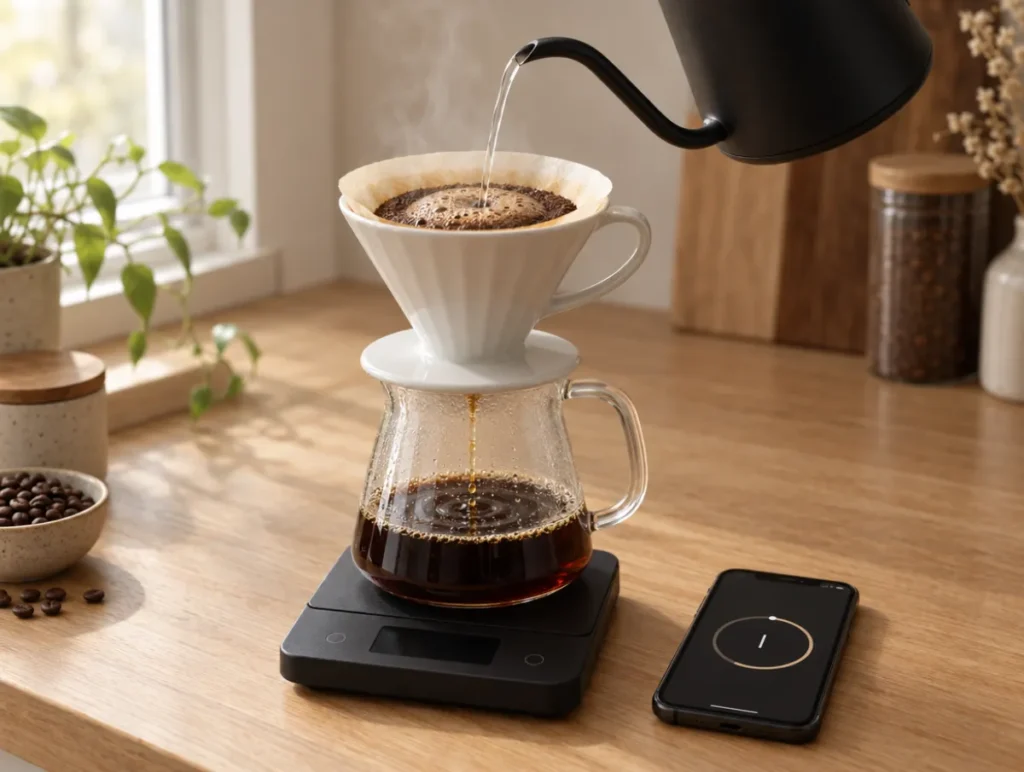
Quick answer: Pick a published pour-over recipe, choose a small (250 g), medium (375 g) or large (500 g) brew, and press Start as you begin pouring. The timer shows the number your scale should read at each step, counts down to the next pour and beeps when it’s time. Every pour target is scaled from the recipe’s own ratio, so the method stays the same whatever size you make.
A pour-over recipe is really a schedule: at time t, the scale should read w grams. Recipe cards print that schedule for one dose, so brewing a bigger or smaller cup means doing the arithmetic over a hot kettle. This timer does that part for you. It holds seven well-known recipes for the V60, Kalita Wave, Chemex and Origami, and it is the second of our free coffee calculators, built in-house by Coffee Informer.
- 1. Recipe
- 2. Size
- 3. Brew
Choose a pour-over recipe
Published recipes from well-known brewers. Pick one, choose a size, and the timer tells you what the scale should read at every step.
In this guide 6 sections
How to pick a pour-over technique
Start with the brewer you own, then pick by how much attention you want to give the brew:
- New to pour-over: Tetsu Kasuya’s 4:6 method. The pours are on a fixed clock and there is no stirring or swirling. Our Codale pour over set review uses it in a flat-bottom dripper too.
- One cup, made carefully: James Hoffmann’s Better 1 Cup V60. Five small pours keep a small bed even.
- Two cups from a V60: Hoffmann’s Ultimate V60. It was published for 30 g of coffee and 500 g of water, which is the large size here.
- You like hands-on technique: Scott Rao’s V60. Its last pour starts when you see the bed about 70% drained, so the timer waits for you to tap Next pour.
- Flat-bottom brewer: Madcap’s Kalita 185 recipe, with even 50 g pulses.
- Brewing for the table: Stumptown’s Chemex recipe, three big pours for a full pot.
- In a hurry: Kurasu’s Origami recipe. The dripper comes off at 1:20, so your cup holds about two thirds of the water you poured.
For a deeper look at the three V60 methods, read our V60 recipe comparison.
The recipes compared
| Recipe | Brewer | Ratio | Time | Difficulty | What its author says it’s for |
|---|---|---|---|---|---|
| Ultimate V60 (James Hoffmann) | Hario V60 | 1:16.7 | 3:30 | Medium | Keeping a full, hot cone; a stir and swirl for an even bed |
| Better 1 Cup V60 (James Hoffmann) | Hario V60 | 1:16.7 | 3:00 | Medium | One small 15 g cup with short, even pulses |
| 4:6 Method (Tetsu Kasuya) | Hario V60 | 1:15 | 3:30 | Easy | A balanced cup you can steer sweeter or brighter |
| Rao V60 (Scott Rao) | Hario V60 (plastic) | 1:16.5 | about 4:15 | Advanced | High extraction (22–24.5%) |
| Kalita 185 café recipe (Madcap Coffee) | Kalita Wave 185 | 1:16.9 | about 3:30 | Medium | A consistent, balanced single cup |
| Chemex for sharing (Stumptown Coffee) | Chemex | 1:16.7 | 4:00 | Easy | A 20 oz pot to share |
| Origami quick brew (Kurasu Kyoto) | Origami Dripper | 1:18 | 1:20 | Medium | A quick, intense extraction |
Difficulty is our own label, based on how many pours there are and how much technique each step asks for. Times are the author’s published targets.
Why scaling the pours works
Each recipe is stored as a list of steps: a start time, a cumulative scale reading and an instruction. When you choose a size, the timer computes one factor and applies it to every number:
k = your_water / recipe_water
dose = round(recipe_dose × k)
target_i = round(recipe_target_i × k)
Because every target is multiplied by the same k, each pour keeps its share of the total. Take the 4:6 method, published as 20 g of coffee to 300 g of water. For a 250 g brew, k = 250 / 300 = 0.833, so the dose becomes 17 g and the five pours land at 42, 100, 150, 200 and 250 g. The first two still add up to 40% of the water and the last three to 60%, which is the whole point of the method.
Two things don’t scale. The timings stay as the author published them, and a deeper bed of grounds usually drains more slowly, so a large brew can run a little past the target time. When you pick a size the recipe wasn’t written for, the timer says so. Grams are rounded to whole numbers, which is as fine as most kitchen scales read. If you want the reasoning behind ratios in general, see our pour over coffee to water ratio guide.
Tips for brewing with the timer
- Put your dripper and cup on the scale, add the coffee, and tare to zero before you press Start.
- Press Start (or the Space bar) as the first water hits the grounds. Every recipe here counts from the first pour.
- Prop your phone where you can see it. The screen stays awake while the timer runs, in browsers that support it.
- Sound is on by default and plays a short beep at each step; phones that support it also vibrate. If your device is set to reduce motion, sound starts off.
- A wet, bubbling bed in the first 30–45 seconds is the bloom doing its job. Our guide to coffee bloom explains why.
- If the brew runs well past its target, the grind is usually too fine. Our V60 stall guide covers the other causes.
A timer can only keep the pours on schedule. How evenly the coffee extracts still comes down to the grind, so if your cups taste sour and bitter at once, look at the best burr grinders for pour over first.
Frequently asked questions
What is a good pour over ratio?
The recipes here run from 1:15 (the 4:6 method) to 1:18 (the Origami recipe). Most sit between 1:16.5 and 1:17, which is roughly 15 g of coffee for a 250 g mug. Start there and adjust to taste.
How long should a pour over take?
Most of these recipes finish between 3:00 and 4:30. The Origami recipe is the exception at 1:20, because the dripper is lifted off before the bed drains.
Can I scale a pour-over recipe up or down?
Yes. Keep the ratio and multiply every pour target by the same factor, which is what this timer does. Expect bigger brews to drain a little more slowly.
Do I need a gooseneck kettle?
It helps with the slow, controlled pours these recipes describe, but any kettle works if you pour carefully. Watch the scale, not the kettle.
Watching your caffeine too? Our caffeine cutoff calculator shows when your last cup of the day should be.
Embed this timer
Sources
- James Hoffmann, The Ultimate V60 Technique (YouTube) (Ultimate V60: 30 g to 500 g, pour schedule and timings)
- Hario USA, James Hoffmann Ultimate V60 Technique (Ultimate V60: 30 g to 500 g, pour schedule and timings)
- James Hoffmann, A Better 1 Cup V60 Technique (YouTube, recipe in the description) (Better 1 Cup V60: 15 g to 250 g, pour schedule and timings)
- Hario UK, V60 recipe and interview with Tetsu Kasuya (4:6 Method: 20 g to 300 g, pour schedule and timings)
- Hario UK, V60 recipe and interview with Scott Rao (Rao V60: 20 g to 330 g, pour schedule and timings)
- Madcap Coffee, How We Brew: Kalita 185 Recipe (Kalita 185 café recipe: 21 g to 355 g, pour schedule and timings)
- Stumptown Coffee, Chemex brew guide (Chemex for sharing: 42 g to 700 g, pour schedule and timings)
- Kurasu, ORIGAMI Dripper brewing recipe: how we do it at Kurasu (Origami quick brew: 15 g to 270 g, pour schedule and timings)
Share this guide
See more Coffee Informer on Google. Add us as a preferred source and our guides show up more in your Top Stories and AI results.
Add as a preferred source on Google