
Quick answer: The best espresso grinder under $200 for most people is a hand grinder. The KINGrinder K6 is the best value at around $109, and the 1Zpresso J-Ultra gives the finest espresso adjustment for about $199. If you want an electric grinder, the Breville Smart Grinder Pro is the easiest push-button choice, and the Fellow Opus 2 suits people who weigh out single doses and also brew filter coffee.
Coffee Informer earns a commission from qualifying Amazon purchases made through links on this page, at no extra cost to you. It never affects which grinders we include.
You bought an espresso machine, and the shots come out sour, thin or gushing far too fast. Very often the machine isn’t the problem. The grinder is.
Espresso needs a grind that is very fine, very even and adjustable in tiny steps. Pre-ground coffee and blade grinders can’t do that, and many budget burr grinders are built for drip coffee. The six grinders below can all grind for espresso, and each was still on sale on Amazon in October 2026.
In this guide 13 sections
- Best Espresso Grinders Under $200 at a Glance
- How We Chose
- Hand or Electric: Which Should You Buy Under $200?
- 1. KINGrinder K6 – Best Value
- 2. 1Zpresso J-Ultra – Best Espresso Grind Quality
- 3. Breville Smart Grinder Pro – Best Electric Grinder
- 4. Fellow Opus 2 – Best for Single Dosing
- 5. Baratza Encore ESP – Best for Repairs and Support
- 6. TIMEMORE Chestnut C3 ESP Pro – Cheapest Way Into Espresso
- Which Grinder Fits Your Espresso Machine?
- What to Look For in a Budget Espresso Grinder
- Final Verdict
- Frequently Asked Questions
Best Espresso Grinders Under $200 at a Glance
| Grinder | Type | Best for | Price* |
|---|---|---|---|
| KINGrinder K6 | Hand, 48 mm burrs | Best value | ~$109 |
| 1Zpresso J-Ultra | Hand, 48 mm burrs | Best espresso grind quality | ~$199 |
| Breville Smart Grinder Pro | Electric, conical burrs | Best electric, push-button dosing | ~$200 |
| Fellow Opus 2 | Electric, 48 mm conical burrs | Single dosing, espresso + filter | ~$196 |
| Baratza Encore ESP | Electric, 40 mm conical burrs | Repairability and support | ~$200 |
| TIMEMORE Chestnut C3 ESP Pro | Hand, 38 mm burrs | Cheapest way into espresso | ~$99 |
*Amazon prices on October 21, 2026. Prices change often, so check the current price before you buy.
How We Chose
This is a research-based guide, not a lab test. We haven’t put these grinders through our own grind-size or retention measurements, so you won’t see made-up test scores here.
Instead, we started with grinders that can actually reach espresso fineness and sell for $200 or less. Then we checked each one’s specs with its maker, read its Amazon rating and review count, and looked for the complaints owners repeat in reviews and on forums such as Home-Barista. Every pick below lists the drawbacks, not only the strengths.
Hand or Electric: Which Should You Buy Under $200?
At this budget, hand grinders give you more grind quality per dollar. With no motor to pay for, the money goes into bigger burrs, tighter bearings and finer adjustment steps. Their weakness is effort: every espresso dose means cranking by hand, and light roasts and fine settings take more force.
Electric grinders under $200 are about convenience. You press a button and walk away, which matters if you make several drinks every morning. The trade-off is that fewer of them grind fine and evenly enough for unpressurized baskets, and their reliability is more mixed.
- Choose a hand grinder if you make one or two espressos a day and want the best shot for the money.
- Choose an electric grinder if you make drinks for a household, hate manual work, or want to grind straight into the portafilter.
1. KINGrinder K6 – Best Value

The K6 is the grinder that made cheap espresso grinding realistic. For about $109 you get 48 mm stainless steel burrs, an all-metal body and an external adjustment dial with 16-micron clicks, 60 clicks per turn (per the Amazon listing).
Owners like it. As of October 2026 it held 4.6 stars from about 1,000 ratings, and the review summary says many buyers feel it performs like a grinder costing twice as much, for both espresso and pour over. Barista Life calls it one of the cheapest grinders that can properly dial in espresso.
Pros
- Large 48 mm burrs for the price
- External dial, so you adjust without taking it apart
- Handles espresso and pour over
Cons
- 16-micron steps are coarser than the J-Ultra’s, so fine-tuning a shot is a little harder
- Some owners report the handle coming loose
- Small hopper (25–35 g per the listing) and slow for big batches
Who it’s for: beginners on a tight budget who want real espresso, not just espresso-style coffee.
2. 1Zpresso J-Ultra – Best Espresso Grind Quality

If espresso is all you care about, the J-Ultra is the strongest grinder in this price range. It uses 48 mm burrs designed for espresso, and its external dial moves in about 8-micron steps (1Zpresso), half the size of the K6’s. That makes small changes to shot time much easier.
It had 4.6 stars from about 400 Amazon ratings in October 2026, with only 2% one-star reviews. CoffeeGeek includes it in its budget grinder guide, and on Reddit some owners compare it with far pricier electric grinders, though that’s opinion, not measurement.
Pros
- Very fine, precise espresso adjustment
- Magnetic catch cup and folding handle
- Comes apart without tools for cleaning
Cons
- Right at the $200 limit
- Some owners find the catch-cup magnets weak
- Not ideal for large batches of filter coffee
Who it’s for: espresso-first home baristas, including manual lever users. A Flair espresso maker needs exactly this kind of fine, consistent grind.
3. Breville Smart Grinder Pro – Best Electric Grinder

The Smart Grinder Pro is the most popular grinder here by a wide margin: 4.5 stars from over 7,000 ratings, and more than 1,000 bought in the past month on Amazon in October 2026.
It has stainless conical burrs, 60 grind settings and Breville’s Dosing iQ timer, which adjusts grind time in 0.2-second steps. It grinds straight into a 50–54 mm or 58 mm portafilter, so it pairs neatly with Breville espresso machines (Breville).
The weak points are well documented. Owners report units stalling or failing after months of use, some coffee staying in the grinder (retention) and a static-prone plastic bin. Some owners also say it won’t go fine enough for unpressurized baskets until they move the upper burr to a finer position, which Breville allows.
Pros
- Push-button timed dosing
- Grinds directly into the portafilter
- Works for drip and French press too
Cons
- Mixed long-term reliability reports
- Retention and static
- May need the upper burr adjusted for finer espresso
Who it’s for: Breville machine owners and busy households who want speed over the last bit of shot quality.
4. Fellow Opus 2 – Best for Single Dosing

The Opus 2 replaces the original Opus with bigger 48 mm conical burrs (up from 40 mm), a stepless dial that covers espresso to cold brew, a dosing cup that fits 54 mm and 58 mm portafilters, and a 2-year warranty (Fellow). Fellow claims near-zero retention and about 9 seconds per espresso dose.
Early owners praise how fast, quiet and tidy it is. Be aware that it’s new: it had only 62 Amazon ratings in October 2026 (4.5 stars), so nobody knows yet how it holds up after years of use. Reviewers also find it stronger for espresso than for light-roast pour over.
Pros
- Low retention, good for weighing single doses
- Stepless adjustment
- Quick and quiet
Cons
- Too few reviews to judge reliability
- Plastic build
- Less impressive for light-roast filter coffee
Who it’s for: people who switch beans often or weigh each dose, and still want an electric grinder.
5. Baratza Encore ESP – Best for Repairs and Support

The Encore ESP is Baratza’s espresso version of its classic Encore. It has 40 mm M2 steel conical burrs and 40 settings: settings 1–20 move in small steps for espresso, and 21–40 in bigger steps for filter. It includes a dosing cup for 54 mm portafilters and a 58 mm adapter ring.
Its biggest strength is Baratza’s support. Parts are easy to buy, and owners often mention the company’s help. But it scores lower than the others: 3.9 stars from about 1,400 ratings in October 2026. Repeated complaints include a cracked plastic burr holder, a rattling hopper, and some units needing the included shims before they grind fine enough.
Pros
- Easy to repair, with parts widely available
- Separate fine range for espresso
- Also good for drip
Cons
- Lowest rating on this list
- Plastic burr holder can crack
- Some units need shimming to go fine enough
Who it’s for: people who value repairability and mostly use pressurized baskets, or split time between espresso and drip. Note that the standard Encore (without ESP) is a drip grinder, not an espresso grinder.
6. TIMEMORE Chestnut C3 ESP Pro – Cheapest Way Into Espresso

At around $99, the C3 ESP Pro is the lowest-cost grinder here that is designed for espresso. It uses 38 mm stainless conical burrs, adjusts in about 0.023 mm clicks, and has an all-metal body with double bearings and a folding handle.
It had 4.6 stars from about 155 ratings in October 2026. Owners praise the build and the consistent grind. The smaller burrs mean more cranking per dose than the 48 mm grinders, and it has far fewer reviews than the K6.
Pros
- Lowest price on the list
- Solid metal build
- Compact enough to travel with
Cons
- Smaller 38 mm burrs grind more slowly
- Fewer reviews than the K6
Who it’s for: anyone who wants to try real espresso grinding for under $100.
Which Grinder Fits Your Espresso Machine?
Check your basket before you choose. Pressurized (dual-wall) baskets, common on entry-level machines, have a single tiny exit hole that builds pressure for you. They forgive a coarser or uneven grind. Unpressurized (single-wall) baskets rely on the coffee itself to create resistance, so they need a fine, even grind you can adjust in small steps.
| Your setup | Good grinder choices |
|---|---|
| Pressurized baskets only | Any grinder here, including the Encore ESP and Smart Grinder Pro |
| Unpressurized baskets, one or two shots a day | 1Zpresso J-Ultra or KINGrinder K6 |
| Unpressurized baskets, several drinks a day | Fellow Opus 2 or Smart Grinder Pro (finer upper burr setting may be needed) |
| Manual lever (Flair and similar) | 1Zpresso J-Ultra, KINGrinder K6 or TIMEMORE C3 ESP Pro |
| Espresso plus drip or pour over | Baratza Encore ESP, Fellow Opus 2 or Smart Grinder Pro |
Still choosing a machine? Our guide to the best espresso machines for home covers which models come with a built-in grinder, so you may not need a separate one at all.
What to Look For in a Budget Espresso Grinder
Burrs, not blades
Blade grinders chop beans into a mix of dust and chunks, which can’t make good espresso. You need burrs. Our guide to how burr grinders work explains conical vs flat burrs and steel vs ceramic.
Small adjustment steps
In espresso, even a small grind change noticeably changes how fast a shot runs. Look for small or stepless adjustment. A useful rule is that the smaller the step, the easier it is to fix sour or bitter shots. Here’s how to dial in espresso grind size once you have it.
Retention and clumping
Retention is ground coffee left inside the grinder, which goes stale and mixes into your next dose. Low-retention grinders like the Opus 2 and hand grinders waste less. If your grounds come out in clumps, see how to fix clumpy coffee grounds.
Effort and speed
Hand grinding espresso is a workout, especially with light roasts. If you’re worried about that, read why hand grinders get hard to turn before buying, or choose electric.
Will you brew filter coffee too?
Espresso-focused grinders can be slow or less even at coarse settings. If pour over matters as much as espresso, compare with our pour-over grinder picks.
Final Verdict
- Best value: KINGrinder K6, real espresso grinding for around $109.
- Best espresso quality: 1Zpresso J-Ultra, the finest adjustment under $200.
- Best electric: Breville Smart Grinder Pro, push-button dosing straight into the portafilter.
- Best for single dosing: Fellow Opus 2, low retention for espresso and filter.
- Best support: Baratza Encore ESP, the easiest to repair.
- Cheapest: TIMEMORE Chestnut C3 ESP Pro, around $99.
If you’re unsure, start with the K6. It costs about half the budget, and owners and reviewers say it grinds fine enough for unpressurized espresso baskets.
Check the KINGrinder K6 price on Amazon
Frequently Asked Questions
Can you get a good espresso grinder for under $200?
Yes. Hand grinders such as the KINGrinder K6 and 1Zpresso J-Ultra grind fine and evenly enough for unpressurized baskets at $100–$200. Electric options like the Breville Smart Grinder Pro and Fellow Opus 2 also reach espresso fineness at this price, with more convenience but more mixed reliability.
Is a hand grinder better than an electric grinder for espresso?
Under $200, usually yes for grind quality, because none of the money goes into a motor. Electric grinders win on speed and ease, which matters if you make several drinks a day.
Is the Breville Smart Grinder Pro good enough for espresso?
For most home machines, yes, especially with pressurized baskets. Some owners say it needs its upper burr moved to a finer position before it grinds fine enough for unpressurized baskets, and long-term reliability reviews are mixed.
Do I need a special grinder for espresso?
You need a burr grinder that can grind very fine and adjust in small steps. Many budget burr grinders are built for drip coffee and can’t go fine enough, so check that the model is rated for espresso.
Baratza Encore vs Encore ESP: which one grinds for espresso?
The Encore ESP. It adds a fine micro-step range (settings 1–20) for espresso. The standard Encore is designed for drip, pour over and French press.
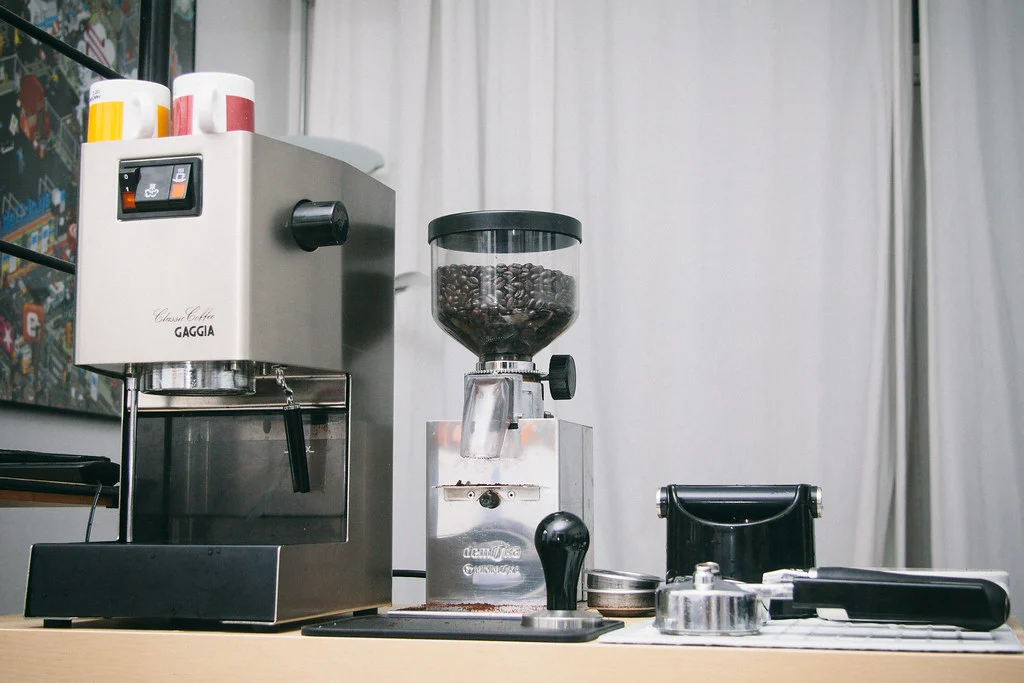
Featured image: “Espresso machine setup” by Guy Sie, CC BY-SA 2.0.
Share this guide
See more Coffee Informer on Google. Add us as a preferred source and our guides show up more in your Top Stories and AI results.
Add as a preferred source on Google