
Quick answer: French press sediment is coffee fines, tiny particles small enough to pass through the metal mesh filter. Some is normal. To cut it down, grind coarser with a burr grinder, let the grounds settle for a few minutes after the steep, skim off the floating foam, press only gently and leave the last bit of coffee in the pot.
A little grit at the bottom of the cup is part of French press coffee; some people even like the extra body. If yours is muddy, here is where it comes from and how to get a cleaner cup without giving up the press.
In this guide 5 sections
Why does my French press coffee have sediment?
French press uses a metal mesh filter rather than paper. The mesh lets coffee oils and very fine particles through, which is why French press tastes fuller than pour-over, and also why there’s sludge in the last sip. Those particles are fines: dust-sized bits that every grinder produces, and more of them the finer you grind.
Is sediment normal in French press coffee?
Yes, a small amount is normal. A thick layer of mud usually points to the grind (too fine or too uneven) or to technique that stirs the fines back up before you pour.
What causes excessive French press sludge?
Your grinder and grind size
This is the biggest factor. Blade grinders chop beans unevenly and make lots of fines; burr grinders crush them to a much more even size. Use a coarse grind: too fine produces more fines and a muddy, often bitter cup. If you buy pre-ground coffee, choose one labelled for French press. Our guide to burr grinders covers what to look for.
Your technique
- Pressing hard and fast churns up the bed and pushes fines through the mesh.
- Pouring straight away after plunging leaves fines suspended in the coffee.
- Pouring every last drop tips the settled sludge into your cup.
A worn or damaged filter
Check the mesh and its seal for bends, tears or gaps around the edge. A damaged screen lets far more grounds through; most presses have replacement screens.
How do you reduce sediment in French press coffee?
A low-sediment French press method
This approach, popularised by James Hoffmann, leaves most of the fines behind:
- Use a coarse grind and your usual ratio (see our coffee to water ratio chart).
- Add hot water and steep for 4 minutes.
- Stir to break the crust, then spoon off the foam and floating grounds.
- Wait another 5–8 minutes so the fines settle to the bottom.
- Lower the plunger just to the surface of the coffee; don’t press it down into the grounds.
- Pour slowly and leave the last bit in the pot.
For our standard recipe and more detail, see how to make French press coffee.
Other fixes
- Upgrade to a burr grinder: the single most effective change.
- Sift your grounds: shake them through a fine sieve to remove dust before brewing.
- Add a paper layer: some brewers cut a paper filter to fit and place it between the mesh screen and its plate for extra filtration.
- Pour through a paper filter: pour the finished coffee through a paper filter in a dripper for a clean cup.
- Pick beans suited to French press: see the best coffee for French press.
Which brewing methods give a cleaner cup?
If you want no sediment at all, use a method with a paper filter:
- Pour-over: a Hario V60 or Chemex gives a very clean cup. Start with our V60 brewing methods.
- AeroPress: immersion like a French press, but pressed through paper. See how to use an AeroPress.
- Clever Dripper: an immersion brewer that drains through a paper filter via a valve.
Frequently asked questions
Is French press sediment bad for you?
The sediment itself is just very fine coffee particles, so it mainly affects texture. The thing worth knowing is that unfiltered coffee, French press included, is a significant source of cafestol and kahweol, natural oils that can raise LDL cholesterol (Higdon & Frei, 2006 review). A paper filter holds most of these back, so if your doctor has flagged your cholesterol, pouring through paper or switching to a paper-filtered method is a sensible step.
Why is my French press coffee muddy and bitter?
Usually the grind is too fine. Fines over-extract, adding bitterness, and slip through the mesh, adding mud. Grind coarser and let the coffee settle before you pour.
Should you press the French press plunger all the way down?
You don’t need to. Lowering the plunger just to the surface of the coffee acts as a strainer without stirring up the settled grounds, which keeps more sediment out of your cup.
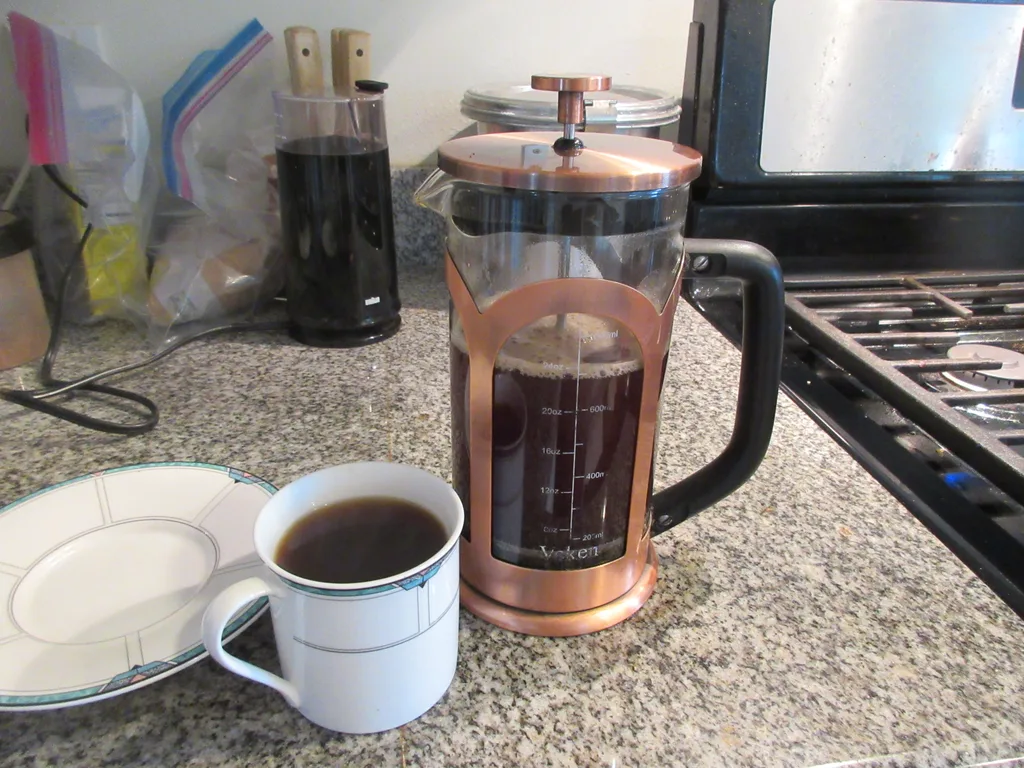
Featured photo: French Press coffee making 18 by Infrogmation, CC BY-SA 2.0, via Wikimedia Commons (cropped).
Share this guide
See more Coffee Informer on Google. Add us as a preferred source and our guides show up more in your Top Stories and AI results.