

Quick answer: Coffee originated in Ethiopia, where legend says a goat herder named Kaldi discovered it. By the 15th century it was grown in Yemen, and it spread across the Arab world by the 16th century, reaching Europe in the 1600s and the Americas soon after. Today it is grown across the tropics and drunk worldwide.

Where did coffee originate, and how did it become one of the world’s favorite drinks? The history of coffee is full of legends, bans and smuggled seeds. This summary draws on the National Coffee Association‘s history of coffee.
Coffee beans journeyed around the world throughout history. They were smuggled out of nations, banned several times, and changed the fortunes of many countries across the globe.
In this guide 7 sections
Where did coffee originate?
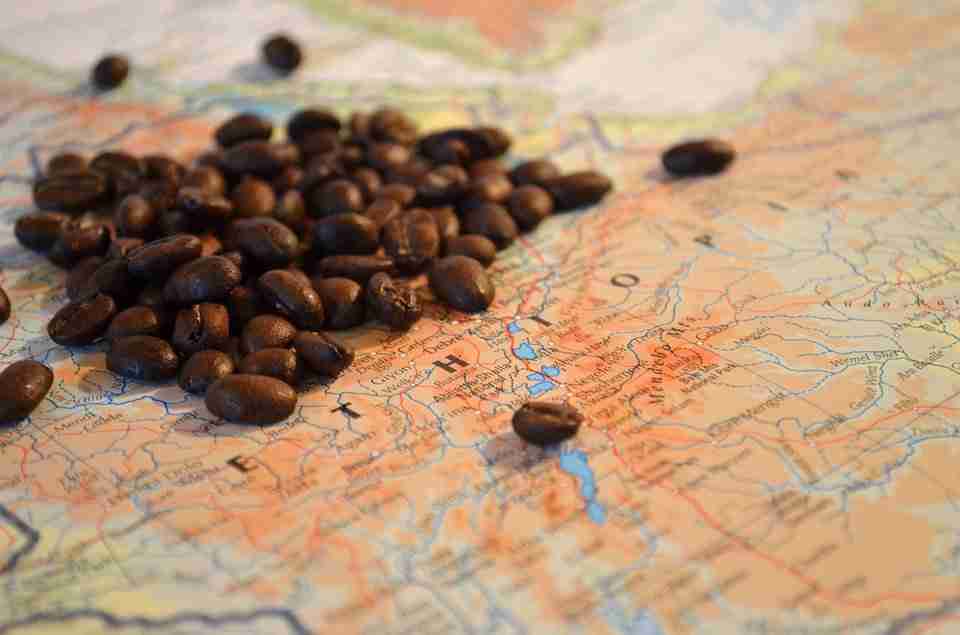
There are several legends of where this little bean got its start, and historians are yet to agree on a specific account. Coffee plants are native to Ethiopia, and the best-known legends come from Ethiopia and Yemen.
Ethiopian coffee history
Many believe that the history of coffee can be traced to Africa, where it was discovered by an Ethiopian goat herder.
Legend has it that a goat herder from Kaffa named Kaldi, who is said to have lived on the Ethiopian plateau around the 9th century, discovered both the plant and its beverage stimulants in a single day. One day, Kaldi noticed that his goats were unusually energetic after eating some berries from a bush, and this made it hard for them to fall asleep as they were bleating loudly and jumping around – almost as though they were dancing.
Puzzled by the excitement of the goats, Kaldi tried the bright red berries for himself, and he noticed the energizing effects on him.
This led him to present his discovery to a local monk who made a drink with the magic fruit and was amazed that he could stay awake all night to pray after consuming the drink. The monk then shared his findings with other monks, and this led to the gradual rise in popularity of coffee.
Another account suggests that the monk doubted the claims, calling the berries “the devil’s work.” So he threw them into a nearby fire, which resulted in a wonderful aroma that drifted through the air. Shortly after, the now roasted beans were retrieved from the fire, ground up, and was boiled to produce a drink.
These are legends rather than recorded history, but they show how closely coffee has been tied to Ethiopia.
Yemen coffee history
While there are several claims that coffee originated from Yemen, only two of these accounts are given some consideration.
According to one of the legends, the Yemenite Sufi Ghothul Akbar Noooruddin Abu al-Hassan al-Shadhili was on a journey when he spotted birds energetically flying over his head.
He got tired and decided to rest for a while before he continued, and then he saw some jettisoned berries. When he tasted them, he noticed that he became unusually alert and was ready to resume his journey in no time.
The second popular origin myth of the beverage involved a certain Sheik Omar, a mentee of Sheik Abou’l Hassan, who was exiled for breaking a moral code. While in a desert close to the mountain of Ousab, he found a tree of red berries and decided to eat them to quench his pangs of hunger.
However, he was unable to enjoy the fruits because they were too bitter, so he threw them into the fire, whence the unmistakable aroma of the bean spread all around. He then collected the roasted beans and boiled them in a bid to soften them. When he noticed the delectable aroma from the increasingly brown liquid, he decided to take a sip of it to see if it tasted well.
Upon noticing the invigorating effects of the drink, he shared his tale with others from his hometown in Mocha, and he was celebrated for the discovery. His exile was lifted and he was allowed to return home again.
How did coffee spread through the Arab world?
Many historians have expressed doubt about the accounts of the origin of coffee in Yemen, and it is generally believed that the coffee found its way to Yemen through its traders who brought the plants back home to cultivate.
By the 15th century, coffee was being grown in Yemen, and by the 16th century it was popular in Persia, Egypt, Syria and Turkey. Coffee houses became social hubs, and pilgrims carried home tales of the “wine of Araby”.
Around 1511, coffee was banned in Mecca on the charges of causing radical thinking and stimulation. The opposition was spearheaded by the Meccan governor Khair Beg, who was scared that the drink would lead to a protest against his government.
Other bans on coffee followed in various places over the years, but none lasted.
Among its many uses, coffee was used as a spiritual intoxicant to aid concentration and improve alertness during nighttime devotions. Arabian traders guarded their supply closely, and fertile seeds were hard to obtain outside Arabia and Africa.
With thousands of pilgrims from all around the world visiting Mecca, it was only a matter of time before word about the “the wine of Araby” began to spread. That near-monopoly broke down in the 1600s. According to a popular legend, an Indian pilgrim named Baba Budan smuggled seeds out and planted them in India, and the Dutch obtained coffee seedlings in the latter half of the 17th century and began growing coffee on Java, in what is now Indonesia.
When did coffee come to Europe?
With fertile beans finding their way out of the Arab world, coffee soon began to spread to the East in India and to the West into Italy and further into Europe. Europeans had their first taste of coffee in the 17th century when merchants brought the beans to wealthy Venetians, who enjoyed it so much and ordered larger quantities of the beans.
The drink was met with suspicion at first: clergy in Venice condemned it in 1615. The controversy grew until Pope Clement VIII was asked to intervene. According to the story, he tasted it, found it delicious and gave it papal approval.
Coffee houses in London
As the 1600s rolled on, coffee found its way into other parts of Europe, including Marseilles, Paris, and Vienna, and England. Coffee houses spread quickly in England, and by the mid-17th century, according to the NCA, there were over 300 of them in London.
By the late 17th century, coffee houses were the go-to place for many people, including merchants, shippers, brokers, artists, and more who spent their time discussing religion, politics, and business. Men spent so much time there that a group of women published a petition against coffee, complaining that their husbands were never at home.
How did coffee become popular in America?
Coffee reached what is now New York City in the mid-1600s, but tea remained the colonists’ favorite drink. That changed after the Boston Tea Party of 1773, the protest against King George III’s tax on tea, after which drinking coffee became something of a patriotic choice.
The Civil War further helped coffee gain prominence, as soldiers relied on it to stay alert. Coffee’s nickname “a cup of joe” also comes from America; read why coffee is called joe.
How did coffee spread around the world?
European colonial powers carried coffee across the tropics. The Dutch grew it on Java, coffee reached Brazil in the 18th century via seeds from French Guiana, and French missionaries brought it to Vietnam in the 19th century. Today it is grown in dozens of countries; see our guide to coffee beans from around the world.
Here are a few notable timelines in the history of modern coffee:
- Ludwig Roselius developed the first commercial decaffeination process in the early 1900s.
- Melitta Bentz developed the paper coffee filter in 1908.
- Nestlé launched Nescafé instant coffee in 1938.
- Achille Gaggia’s lever espresso machine, introduced in the 1940s, created the crema-topped espresso we know today.
- The first Starbucks was opened in Seattle in 1971.
Frequently asked questions
Where did coffee originate?
Coffee originated in Ethiopia, where coffee plants grow wild. It was first cultivated and brewed as a drink on a large scale in Yemen.
Who discovered coffee?
Nobody knows for sure. The most famous legend credits Kaldi, an Ethiopian goat herder who noticed his goats became energetic after eating coffee berries, but it is a story rather than documented history.
When did coffee come to America?
Coffee reached what is now New York City in the mid-1600s. It overtook tea as Americans’ favorite drink after the Boston Tea Party in 1773.
For more trivia, see our fun facts about coffee.
Share this guide
See more Coffee Informer on Google. Add us as a preferred source and our guides show up more in your Top Stories and AI results.
Add as a preferred source on Google
Very interesting story and easy to read.